Probably the biggest difference between call money and fixed-term deposits revolves around a very simple question: How quickly do I need my money back? With call money, the answer is clear: at any time. It offers you maximum flexibility and daily access. Fixed-term deposits, on the other hand, are the exact opposite. Here you put your money aside for a fixed term at a guaranteed interest rate.
So your decision depends entirely on your personal situation – do you need a buffer for unexpected expenses, or can you “park” an amount for a secure and predictable return for a while?
What really distinguishes call money from fixed-term deposits

It’s best to think of the two forms of saving as two different tools in your own financial toolbox. The call money account is like your financial parking lot for everyday life. This is where you park money that you may need at short notice – the ideal place for a nest egg or reserves for your next vacation. However, the interest rate is variable and can go up or down depending on the market situation.
In comparison, a fixed-term deposit account is more like a safe with a time lock. You lock away an amount for a fixed period of time and receive a guaranteed, often higher interest rate in return. This ability to plan is the unbeatable advantage, but it comes at the cost of sacrificing flexibility.
Call money vs. fixed-term deposits in direct comparison
A direct comparison helps to get to the heart of the differences. This allows you to see at a glance which form of saving could be the better choice for your goals.
| Feature | daily allowance | Fixed deposit |
|---|---|---|
| Availability | Available at any time and every day | Not available during the term |
| Interest rate | Variable, can change at any time | Fixed and guaranteed for the entire term |
| Runtime | Unlimited, no fixed term | Fixed term (e.g. 6 months, 2 years) |
| Ideal for | Nest egg, flexible reserves | Planned purchases, secure returns |
This table clearly shows the core differences.
Let’s imagine you have 10,000 euros left over and are wondering what to do with it. With an overnight deposit account, you could access it again tomorrow if the washing machine breaks down. With a fixed-term deposit, the money is tied up for the agreed term, but you know from day one exactly how much interest you will receive at the end.
In terms of security, both are absolutely equal: in Germany, your money is protected by the statutory deposit guarantee up to 100,000 euros per customer and bank. If you want to delve deeper into the practical differences, you can find more useful information on reisetopia.de.
The decisive factor is your savings goal. Do you possibly need the money in the short term? Then call money is the right choice. Can you safely do without it? Then secure a predictable return with fixed-term deposits.
How interest really makes your savings work
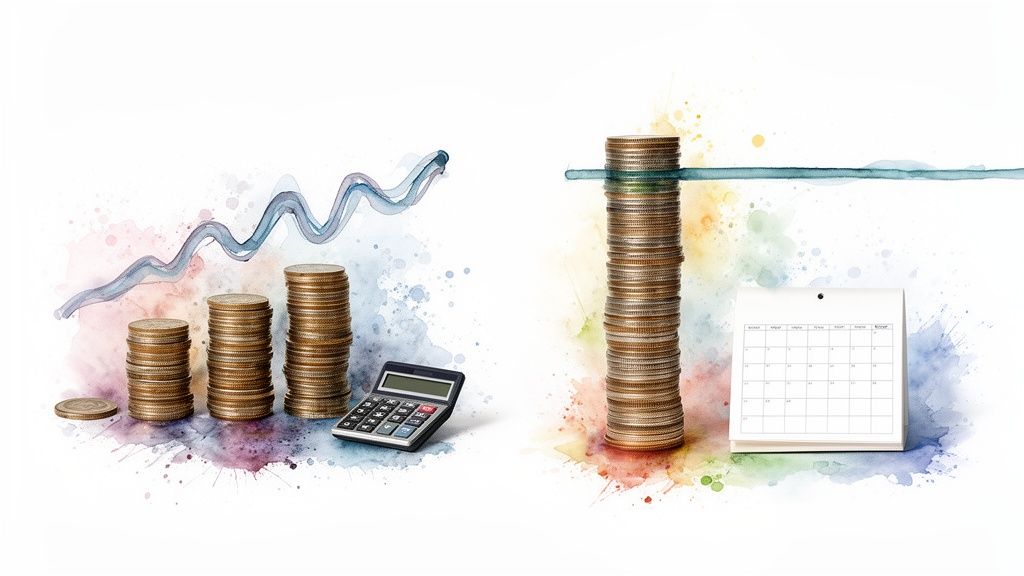
The point at which call money and fixed-term deposits differ fundamentally is the interest rate. It is at the heart of both forms of investment and the engine that increases your money. The interest rates on call money accounts are variable. This means that the bank can adjust the interest rate to the general market situation at any time – both upwards and downwards.
These adjustments usually follow the monetary policy of the European Central Bank (ECB) directly. If the key interest rate climbs, overnight interest rates usually follow suit. If the ECB lowers it, you will often feel the impact on your earnings. This means that you are there when things happen on the interest rate market and benefit from upward movements, but you also have to put up with lean periods.
Fixed-term deposits: predictability as the greatest asset
The world looks quite different with fixed-term deposits. Here, the interest rate is fixed and guaranteed for the entire term when the contract is concluded. Period. Whether interest rates on the market go through the roof or plummet in the coming months – your rate remains rock solid.
This stability gives you invaluable planning security. You know from day one exactly what return you can expect in the end. That’s the deal: you exchange flexibility for a guarantee. You can’t benefit from sudden interest rate rallies, but in return you are completely immune to falling interest rates.
The key idea is: call money is a reflection of the present, fixed-term deposits are a bet on the future. With fixed-term deposits, you effectively freeze today’s interest rate for tomorrow.
Interest in practice: a calculation example
Let’s run through the whole thing with real figures. Let’s assume you want to invest 10,000 euros. The interest rate landscape in recent years has shown how differently the two models have developed. While top call money rates fluctuated widely, a fixed-term deposit offered an average of 2.80 % for six months. New customers were often able to secure short-term offers of up to 3.5% on call money. For a deeper insight into the market dynamics, it is worth taking a look at historical interest rate developments on datapulse.de.
Let’s take a look at three possible scenarios for your 10,000 euros:
-
Scenario 1: Stable interest rates
You opt for a fixed-term deposit with 3.0% p.a. – this will earn you 300 euros after one year. A call deposit account yields an average of 2.8% p.a. over the same period and yields 280 euros. Fixed-term deposits are just ahead here. -
Scenario 2: Rising interest rates
You have taken out your fixed-term deposit at 3.0%(300 euros return). However, the market interest rate rises and an overnight deposit account would have yielded an average of 3.5% – i.e. 350 euros. In this case, the flexibility of the call money would have been worth its weight in gold. -
Scenario 3: Falling interest rates
Once again, you secure the 3.0 % fixed-term deposit(300 euro return). However, market interest rates collapse and your call money is bobbing along at an average of 2.0%, which means only 200 euros. The interest guarantee on the fixed-term deposit has paid off in full.
These examples put it in a nutshell: your decision depends heavily on your personal assessment of interest rate trends and your risk appetite. If you are unsure, it is always a good strategy to compare different interest rates before investing your money.
Call money vs. fixed-term deposits: How quickly can you really get your money?
Having money in your account is one thing. But how quickly you can access it in an emergency is quite another. It is precisely at this point – availability – that the biggest and most important difference between a call money account and a fixed-term deposit account becomes apparent.
Think of your call deposit account as your financial “fire department”. It’s your emergency fund that’s immediately on hand if there’s a fire. The washing machine breaks down, an unexpected car repair blows your monthly budget or a hefty dentist bill comes through – your call money is there for just such moments. Your money is available at all times. A quick online transfer to your current account and you can usually access it the very next working day. So simple, so flexible.
Fixed-term deposit: When waiting should pay off
The situation is completely different with fixed-term deposits. Here, you deliberately put your money aside for a fixed period of time and in return forgo quick access. This is not a disadvantage, but the essence of the product: you “park” your money for an agreed term – and the bank rewards you with a guaranteed, often higher interest rate.
However, early termination is not usually provided for here. If it does have to be done, the banks will make you pay dearly. And “expensive” means here:
- Loss of interest: The bank often simply cancels all the interest you would have earned by then.
- Penalty fees: Some institutions charge a fee on top of this for the effort involved in terminating the contract prematurely.
- A resounding no: In many contracts, early termination is simply excluded, unless there is a case of extreme hardship.
Remember: the guaranteed interest rate on fixed-term deposits is, so to speak, compensation for keeping your hands off your money for a while. You exchange flexibility for predictability.
A look at specific everyday examples
Let’s assume you have 10,000 euros in your bank account. Where do you put it? That depends entirely on what you plan to do with the money.
-
Case A – The buffer for all eventualities: The money should be your safety net, your nest egg for unforeseen events. You need to be able to access it at any time. There are no two opinions here: The call money account is the only sensible choice.
-
Case B – The savings goal firmly in sight: You know very well that you want to buy a new car in two years’ time. You won’t need the money until then. Perfect for a fixed-term deposit account with a two-year term. In this way, you secure today’s interest rate for the entire term and know exactly what you will get in the end.
It is precisely these different applications that make it clear why both forms of saving are so popular in Germany, even though their returns often do not even beat inflation. According to a study, 72 percent of Germans put money aside regularly or irregularly. The choice between call money and fixed-term deposits is always a trade-off between the need for security and the desire for flexibility. You can find out more about the most popular forms of saving among Germans at Finanztip.
Immediate availability is therefore not just a feature of call money, it is its very purpose. Just as the interest guarantee is at the heart of fixed-term deposits. By the way: good financial planning starts with the daily control center. Read on to find out how to find the best current account for your needs and create a solid basis for all your savings plans.
Finding the right investment strategy for your personal situation
The technical details are one thing, but the really important question is: what does all this mean for you and your money? The best answer is not to be found in the product descriptions, but by taking a look at your own life and your financial goals. It’s simply about choosing the right tool for the job.
A good strategy always starts with an honest inventory. This applies to everyone, but especially to young people, such as students who work part-time. Here, clever financial management during your studies is often the foundation for later financial success.
What type of investor are you?
To help you decide, let’s take a look at two typical savers. Do you recognize yourself?
Profile 1: The flexible pension provider
Imagine you are building up your nest egg. Your goal: a secure reserve of three to six months’ salary for all the unforeseeable things in life – a broken washing machine, an expensive car repair or if things don’t go smoothly at work. One thing counts above all: flexibility.
For this purpose, the call deposit account is simply unbeatable. You can deposit money at any time and, more importantly, withdraw it immediately without any disadvantages such as loss of interest or penalty fees. Every euro you put aside starts earning interest immediately, but always remains ready to hand.
Profile 2: The safety-oriented planner
Now another scenario: you have a clear goal in mind that lies in the future. Perhaps the deposit for a condominium in exactly three years’ time or the dream car you want to treat yourself to then. You have already saved a fixed amount for this, which you don’t have to touch until then.
This is where fixed-term deposits really come into their own. You fix the amount for exactly three years and secure the interest rate that applies today for the entire term. This absolute predictability protects you from interest rate fluctuations and gives you the security of achieving your savings target down to the last cent.
The choice does not depend on what is “better” across the board, but on the mission your money is supposed to fulfill. Call money secures the present, fixed-term deposits plan for the future.
The following decision tree gets to the heart of your investment strategy.
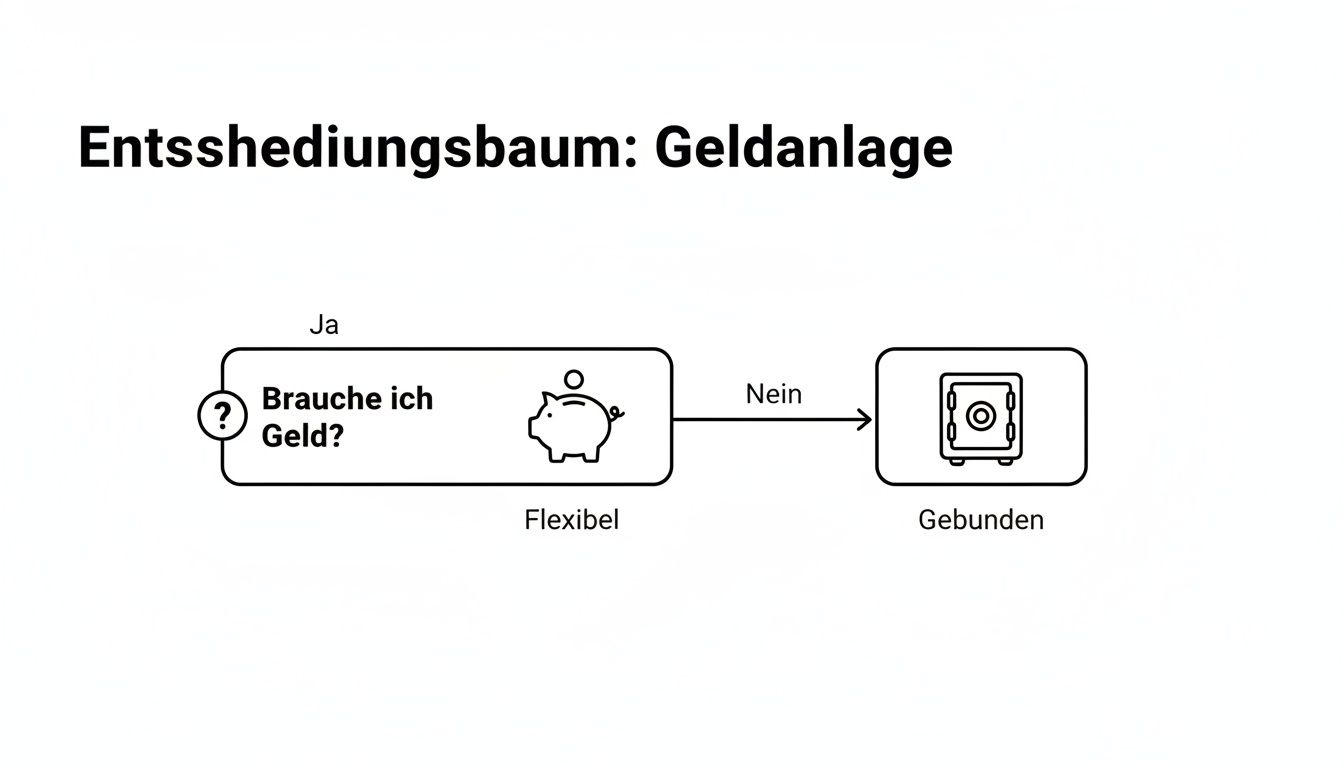
As the graphic shows, the question of availability is the most important switch you need to make.
What type of investor are you?
The following table will help you to categorize your own situation and find the right type of investment. Think of it as a kind of cheat sheet for your finances.
| Savings target / situation | Recommended form of investment | Reason |
|---|---|---|
| Building up the nest egg | daily allowance | The money must be available immediately in an emergency, without losses. |
| Save for your next vacation in 9 months | daily allowance | The term is short and the flexibility to add something extra is important. |
| Purchase of a new car in 2 years | Fixed deposit | You secure a fixed interest rate for 2 years and can plan the target precisely. |
| Money for the down payment on a property in 5 years | Fixed deposit | A long-term, fixed goal benefits from the ability to plan and the often higher interest rates. |
| Unplanned inheritance whose use is still uncertain | daily allowance | Park the money safely and flexibly until you have a clear plan. |
| Long-term wealth accumulation (over 10 years) | Other asset classes | Overnight money and fixed-term deposits are rather unsuitable here; equity ETFs should be examined. |
These examples show: It’s always about the purpose and the time horizon.
The hybrid strategy for maximum efficiency
The reality for most savers is that neither one nor the other is the only perfect solution. The smartest way forward is often a hybrid strategy that cleverly combines the best of both worlds.
A proven and really sensible approach looks like this:
- Pour the foundation: First build up your nest egg in a call money account. A sum of 3 to 6 net monthly salaries is a solid figure here. This money is your financial safety net and will not be touched for other purposes.
- Implement goals: You can plan any money that exceeds this nest egg for specific goals. This capital can be strategically allocated to fixed-term deposit accounts with different maturities (keyword: fixed-term deposit ladder).
This combination gives you the flexibility you need for everyday life and at the same time the planning security and usually better interest rates for your medium-term plans. You can find even more practical money advice in our articles on personal finance. This will help you find the perfect balance for your individual financial situation.
Security and taxes: What really counts in the end
Interest and flexibility are one thing, but what about the security of your money and what is left of the return after tax? These two points are at least as important, because they determine whether your investment strategy really works. Let’s take a closer look.
Let’s start with the topic that is particularly important to us Germans: safety. I can reassure you here, because there are no winners or losers when it comes to this criterion. Both your overnight money and your fixed-term deposits are well protected with banks within the EU.
This is ensured by the statutory deposit guarantee. This is like a safety net and protects your deposit up to 100,000 euros per customer and bank if the institution should ever falter. This makes both forms of investment an extremely safe bet when it comes to preserving capital and sleeping soundly. We have prepared more background information on the subject of financial security for you in other articles.
Cleverly manage taxes on interest
An often underestimated but crucial point: taxes. In Germany, you have to pay withholding tax on your interest income – a flat rate of 25%, plus solidarity surcharge and, if applicable, church tax. Your bank conveniently retains the money directly and pays it to the tax office as soon as the interest lands in your account.
But there is a simple and completely legal trick to optimize this: the saver’s allowance. This means that your investment income remains tax-free up to a certain limit.
- For single people, this amounts to 1,000 euros per year.
- For married couples/cohabiting partners who are jointly assessed, it is 2,000 euros per year.
To make sure the bank knows this, you need to take action and set up an exemption order. By doing so, you are effectively saying to your bank: “Hey, please don’t deduct any tax up to this amount!”
My urgent advice: Set up the exemption order immediately when you open the account. This will ensure that not a single cent goes to the tax office unnecessarily.
The small print: minimum investment and other hurdles
Last but not least, you should always take a look at the practical conditions. While you can usually open an overnight deposit account with just one euro, the situation is often different for fixed-term deposits. Here, many banks require a minimum investment amount, which can range from 500 euros to 5,000 euros or more.
Sometimes there is also an upper limit, i.e. a maximum investment amount, but this is not usually relevant for most of us. Nevertheless, check these conditions carefully before you sign. It’s these small details that ultimately decide which offer really suits your situation and plans perfectly and protect you from unpleasant surprises.
Develop your personal savings strategy
After taking a close look at call money and fixed-term deposits, one thing is clear: there is no one-size-fits-all solution. The question is not which is generally better, but which is best for you personally. Your savings goals, your life situation and how important immediate access to your money is to you – these are the decisive factors.
At the end of the day, it’s a strategic decision. Should your money be available as a flexible cushion for all eventualities? Or can you “lock it away” for a while to achieve a guaranteed return? The answer to this question is the compass for your investment strategy.
Call money as a flexible cushion, fixed-term deposits for clear goals
Basically, it’s quite simple. Think of your call money account as the foundation of your finances. It’s the safe haven for your nest egg – the iron reserve that you need to be able to access at any time if something happens.
Fixed-term deposits, on the other hand, are the perfect tool for clearly defined, medium-term plans. Whether it’s the deposit for your own home in three years’ time or a new car in 18 months’ time: Here you nail down the interest rate and know from the outset what the final outcome will be.
The smartest way is often not an either-or, but a clear both-and. Take advantage of the strengths of both forms of investment. This way you remain flexible and at the same time secure guaranteed interest on part of your money.
A strategy that combines both could look like this, for example:
- Lay the foundations: Park three to six net monthly salaries in a call money account. This is your nest egg that lets you sleep soundly and protects you from unforeseen expenses.
- Set your sights on your goals: Anything in excess of this buffer can be invested in fixed-term deposits. Choose terms that exactly match your plans.
This division creates a really healthy balance. As interest rates are constantly changing, it’s worth comparing offers from time to time to get the best value for your money. If you want to delve even deeper into the subject, you will find many more practical tips in our financial planning section. With this knowledge, you’ll be well equipped to make a confident and smart investment decision.
Frequently asked questions
There are always the same uncertainties surrounding call money and fixed-term deposits. That’s quite normal. Here I have answered the most important practical questions for you – briefly, clearly and to the point, so that you can make the right decision for your money.
Can I terminate a fixed-term deposit account early?
Honestly? You shouldn’t even try. It is virtually impossible to close a fixed-term deposit account prematurely and, if at all, only intended for absolute emergencies.
If the bank agrees to this, you will suffer painful financial losses. In most cases, this means that all the interest you have earned so far is gone. The bank retains it as a kind of “penalty fee”. This is precisely why the golden rule applies: only invest money as a fixed-term deposit that you are guaranteed not to have to touch for the entire term.
You could say that fixed-term deposits are a pact: the bank gives you a fixed, often higher interest rate and you give it planning security in return by giving up your money. If you break this pact, it comes at a price.
What happens to my call money if interest rates fall?
This is where the biggest difference to fixed-term deposits becomes apparent. The interest rates on your call money account are not set in stone; they are variable. So when the European Central Bank (ECB) lowers the key interest rate, most banks follow suit and adjust their call money rates downwards.
Of course, the money you have saved remains untouched, but it simply yields less. The huge advantage for you, however, is your freedom: you can move your money to another bank with a better offer at any time, without notice period and without losses. One click and the money is on its way.
Does a combination of call money and fixed-term deposits make sense?
Yes, absolutely. For the vast majority of savers, this is not only a good idea, but the best strategy of all. You simply combine the best of both worlds and build an unbeatably flexible and stable financial foundation.
This division has proven itself in practice:
- The call money account as a safe haven: This is where you keep your emergency fund – i.e. the money for all unexpected things in life. A good rule of thumb is three to six net monthly salaries. That way, you’ll always be liquid, no matter what happens.
- The fixed-term deposit account for planned goals: Everything that goes beyond this nest egg and is intended for a specific goal in the next few years (e.g. a new car, a deposit for an apartment) should be placed in a fixed-term deposit. There you can secure the often better and, above all, guaranteed interest rates and get closer to your goal in a plannable way.
With this mix of buffer and savings turbo, you are equipped for everyday life and can plan your future with peace of mind.
Would you like to find the best conditions for your savings goals or financing? At Finanz-Fox you can compare transparent offers and shape your financial future simply and digitally. Discover your options now at finanz-fox.de.