
Anyone who has ever been faced with the decision to take out a loan will be familiar with this: juggling figures, installments and terms. However, being able to calculate the loan term is far more than just a dry math exercise. It is the key to making a truly informed financial decision. Ultimately, it determines how high your monthly burden will be and how much you will actually end up paying for the money you borrow.
Why the right loan term determines your financial destiny
Think of the term of a loan as the gearshift in your financial gearbox. You decide whether you want to get to your destination quickly and cheaply or take a longer, more comfortable but significantly more expensive route.
A short term means you are stepping on the gas. The monthly installments are higher, which of course requires a little more discipline. The reward for your efforts? The bottom line is that you pay noticeably less interest and are out of debt in no time. That saves you money.
A long term, on the other hand, feels more relaxed at first. The monthly burden is reduced and you immediately have more room in your budget. The catch, however, is that the interest accumulates over the years to a considerable sum. What initially looks like a small, convenient installment turns out to be an expensive compromise in the end.
A direct comparison of how the term affects your costs
Let’s make it concrete so that the difference is really tangible. Let’s assume you need a loan of 10,000 euros and are offered an interest rate of 4% per year.
The following table shows in black and white how the term affects your monthly installment and the total interest costs.
| Term (months) | Monthly installment | Total interest costs | Total repayment |
|---|---|---|---|
| 36 | 295,24 € | 628,64 € | 10.628,64 € |
| 48 | 225,27 € | 832,96 € | 10.832,96 € |
| 60 | 184,17 € | 1.050,20 € | 11.050,20 € |
| 84 | 136,13 € | 1.434,92 € | 11.434,92 € |
Just one look at the figures makes it clear: extending the term from 36 to 60 months lowers the rate by over 100 euros, but almost doubles the interest costs! This is precisely the trade-off that needs to be understood.
The choice of term is always a balancing act. You weigh up your current monthly liquidity against the total long-term costs. A well-informed decision will prevent you from turning a short-term relief into an expensive, long-term financial burden.
A widespread phenomenon
Incidentally, you are not alone in this consideration. In 2022 alone, around 9.1 million new installment loan agreements were concluded in Germany. According to Statista, this figure has more than doubled since 2006, which shows how commonplace loans have become for private households.
Choosing the right term is therefore not a minor matter, but a real core competence for anyone who wants to have their finances under control. It is the foundation for a decision that suits your life situation and your goals. This applies to small installment loans as well as very large projects. If you are currently looking at larger sums, our article on the importance of comparing real estate financing may be a good next step for you.
How to really understand the repayment term formula
Don’t worry, you don’t have to be a math genius to calculate the term of your loan. But it definitely doesn’t hurt to understand the logic that makes banks tick. At the heart of it all is the so-called annuity formula – a word that sounds more complicated than it actually is.
Imagine the whole thing as a scale with three weights:
- Your loan amount: How much money do you need?
- The interest rate: What does the money you borrow cost you?
- Your desired installment: What are you able and willing to pay back each month?
These three factors are inextricably linked. If you change one of them, the balance tips and the others have to adjust. Understanding this interplay is the key to not just reading credit offers, but really seeing through them and keeping the reins in your hands.
The logic behind the calculation
The real hurdle is not the formula itself. It only gets tricky when you want to rearrange it so that the running time – usually referred to as “n” in mathematics – is on one side alone. And this is where an old friend from school comes knocking at the door: the logarithm.
But don’t panic, you don’t have to start calculating logarithms in your head now. The only important thing is the principle behind it: The logarithm is, so to speak, the tool to free the “n” from its position in the exponent. It cracks the complex compound interest calculation and makes it solvable for us.
The following diagram illustrates this process quite well. It shows how the balance of factors results in your personal credit reality: Either a short term with higher rates or a longer term with more financial breathing room each month.
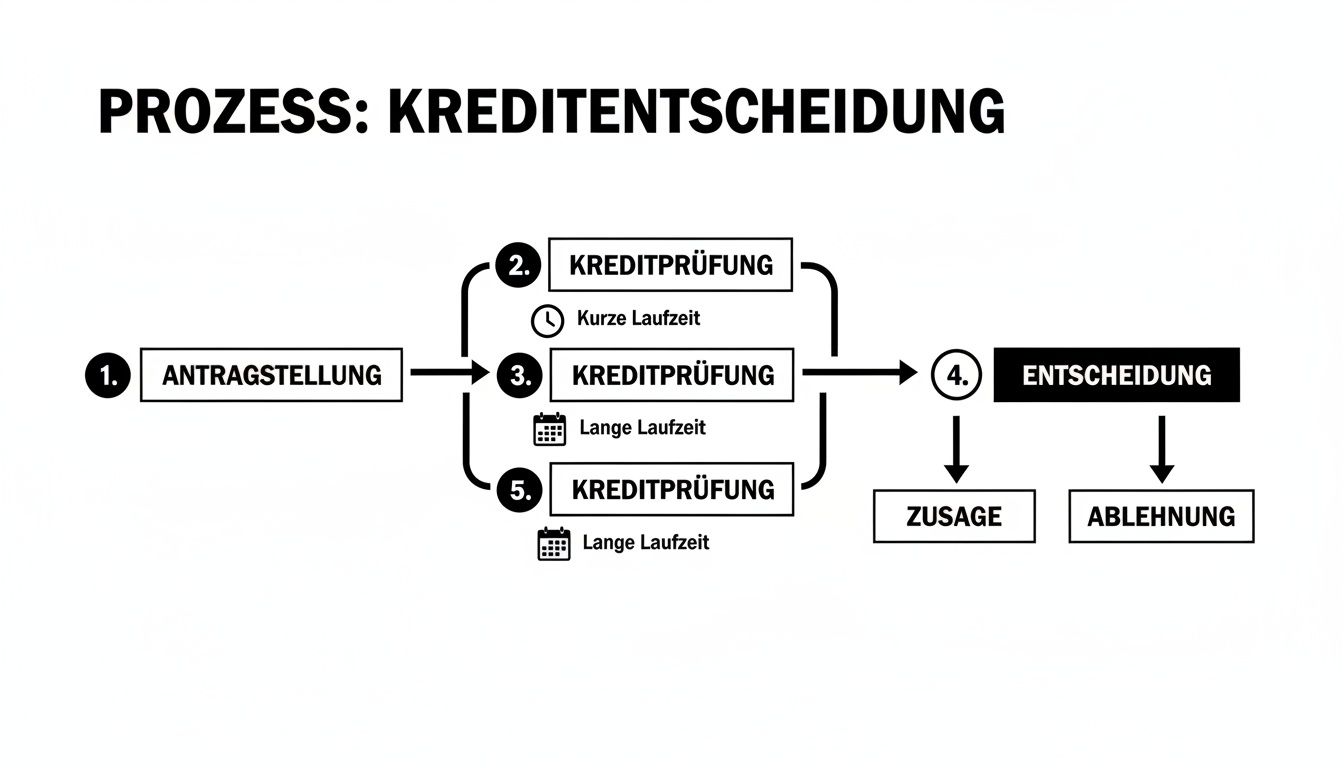
At the end of the day, it’s always a compromise between getting out of debt quickly and having monthly flexibility. This awareness is the absolute basis for sound financial planning.
An important thought: It’s not about memorizing the formula. It is much more important to develop a feel for how much a small adjustment to the interest rate or installment can affect the entire term and therefore your costs.
A brief look at mathematics
The annuity formula in its basic form is actually used to calculate the monthly installment. This is what it looks like when you look at it in its pure form.
However, in order to determine the running time “n” from this, the mathematical conversion that brings the logarithm into play is necessary.
Fortunately, we live in the 21st century and no longer have to do this with pen and paper. Any good loan calculator, such as our Finanz-Fox calculator, will do this for you. It acts as your personal translator, turning your wishes – i.e. loan amount and installment – into the exact term in a flash. If you already know the basics of installment loans and how they work, using such tools becomes even more intuitive.
So the real power lies in knowing which adjustments you can make. A monthly payment that is just 20 euros higher can shorten the term of a typical consumer loan by several months. In the end, this can quickly save you several hundred euros in interest. Try it out for yourself with our calculator in the next step.
What the credit period looks like in real life: Three typical cases
Of course, all this theory is useless if you can’t apply it to real life. Let’s run through the whole thing using three everyday situations that we all know in one way or another. This is how dry figures become tangible, personal financial stories.

Each of these cases requires a slightly different approach. But they all show impressively how powerful it is when you really understand the connections.
Case 1: The car purchase
Let’s imagine that your dream car is just around the corner and costs 20,000 euros. After all fixed costs, you have 350 euros left over each month, which you budget for financing. The bank makes you an offer with an effective annual interest rate of 4.5%. The crucial question now is: How long will it be before the car is really yours?
If you enter these figures into a loan calculator, you end up with a term of 64 months. That’s five years and four months.
- Total interest costs: Over the entire period, you will pay 2,482 euros for interest alone.
- Total repayment: In the end, 22,482 euros are returned to the bank.
This simple calculation provides immediate clarity. You not only know when you will be debt-free, but also what the financing will actually cost you on balance.
Case 2: Debt rescheduling
A classic and often very clever move: rescheduling an old, expensive loan. Let’s assume you still have an outstanding debt of 25,000 euros at a fairly unfavorable interest rate. After some research, you find a new offer with only 3.8% interest and see that you can afford a monthly installment of 500 euros. How quickly could you get rid of the old debt?
The calculation results in a term of 55 months – i.e. four years and seven months. This is often much quicker than you would have needed with the old contract. Rescheduling your debt not only saves you money on interest, but also gives you a clear, manageable time horizon until you are debt-free.
Debt rescheduling can be one of the most effective ways to actively shorten your loan term. With a better interest rate, a larger part of your installment simply goes directly to repayment and not to interest – this speeds up the whole process enormously.
Case 3: Construction financing
When it comes to construction financing, the issue of the term becomes even more critical. After all, we are talking about large sums and very long periods of time in which the fixed interest rate plays a huge role.
The right term can make a difference of thousands of euros, especially for construction financing in Germany. At the beginning of 2026, building interest rates for a 10-year fixed interest rate average 3.85% and 4.0% for 15 years. For a 300,000 euro loan, a 10-year fixed rate means monthly installments of around 1,400 euros, while 15 years reduces the installment to 1,250 euros – but costs 15,000 euros more in interest. Since the historic low in 2020 (1.02% for 5-10 years), interest rates have risen sharply, reaching highs of 3.92% in 2023 and now stabilizing around 3.5% to 3.8%.
An amortization schedule makes this process perfectly visible. It shows you month by month how the portion that goes towards repayments grows, while the interest portion of your installment continues to shrink.
Exemplary amortization process (the first 3 months from our car loan example):
| month | Residual debt (start) | Rate | Interest portion | Repayment portion | Residual debt (end) |
|---|---|---|---|---|---|
| 1 | 20.000,00 € | 350 € | 75,00 € | 275,00 € | 19.725,00 € |
| 2 | 19.725,00 € | 350 € | 73,97 € | 276,03 € | 19.448,97 € |
| 3 | 19.448,97 € | 350 € | 72,93 € | 277,07 € | 19.171,90 € |
These examples make it clear that calculating the credit period is much more than just dry math. It’s a strategic tool that helps you stay in full control of your finances – whether for small desires or big life projects. Even with short-term financing such as mini-loans, a clear understanding of the term is crucial, as you can read in our article on mini-loan options.
What you should look out for when choosing a term – the typical pitfalls
Finding the perfect term for a loan is a bit of a balancing act. From my experience, I can say that many people fall into traps here that end up costing a lot of money. It’s about making a conscious decision that goes further than just the next monthly installment.
The classic mistake is to focus on the lowest possible rate. Sure, a long term makes the monthly charge look temptingly low at first glance. But the total costs literally explode. Over the years, you pay interest that quickly adds up to several thousand euros – money that you could have invested much better or used for other things.
When the budget is on the edge
However, the exact opposite is at least as risky: an installment that is far too tight. Anyone who chooses a term that is so short that the monthly charge stretches the budget to the last cent is permanently living at the financial limit. Even an unexpected car repair or a large utility bill can bring the whole house of cards crashing down.
A good buffer is not a luxury, but an absolute necessity. Always plan your installment so that you still have room for unforeseen expenses after the direct debit. This will save you from an expensive overdraft or even a late payment.
Another stumbling block I often see is the issue of flexibility. Many people only look at the interest rate and overlook the small print on special repayments or installment breaks. However, it is precisely these options that are your most powerful tool for actively influencing the term later on.
Smart strategies for the right runtime
To avoid these mistakes, there are a few tried-and-tested tactics that we at Finanz-Fox always recommend:
- Use un scheduled repayments as a turbo: even small, irregular additional payments – whether through a tax refund or Christmas bonus – can massively shorten the term. So make sure that your contract allows for free unscheduled repayments. Every extra euro you repay will save you money in interest.
- Demand flexibility: Look specifically for offers where you can adjust the installment if necessary or even skip a month. This will give you priceless security in case things do get tight financially.
- Use your credit rating as a trump card: A good credit rating not only secures you better interest rates, but often also better conditions for the term structure. Use this advantage in negotiations. To strengthen your position, we will show you how to successfully apply for a loan with the right preparation.
If you keep these points in mind, the choice of term will turn from a potential cost trap into a strategic tool for your financial stability. This way, you stay in control and ensure that the loan works for you – and not the other way around.
Credit calculator for strategic planning: now it’s your turn
Enough of the gray theory. Knowing the formulas for the repayment term is one thing, but it gets really exciting when you turn the knobs yourself. And that’s exactly what we’ve built our free loan calculator for – it’s your sparring partner for sound financial planning.

Simply leave the complicated formulas to one side. Instead, type in your desired amount, the interest rate and your planned monthly installment. Our calculator will provide you with the answer to the crucial question in a flash: How long will your financing run for? This makes it the perfect tool for playing through various scenarios without any risk.
Planning games for your financial future
What would happen if you could increase your rate by 50 euros a month? How much would the term be shortened if you could get an offer with a 0.5% better interest rate? Play it out and see live how every small adjustment has a direct impact on your monthly payment and, above all, on your total costs.
Such simulations are worth their weight in gold to get a real feel for the figures. You can immediately see how closely the term and interest costs are linked. A look at the development of interest rates in Germany underlines this: top interest rates for loans over 5 years are around 3.39 %, while the figure for 10 years is already 3.48 %.
A concrete example? With a 100,000 euro loan with 3.56% interest and a 10-year term, you end up with an installment of 990 euros and end up paying a whopping 18,800 euros just for interest. If you shorten the term to 60 months (5 years), the installment increases to 1,820 euros, but the interest costs are almost halved to 9,200 euros. Our calculator makes this huge difference crystal clear.
My tip: Consider the interactive repayment plan as your compass to freedom from debt. It shows you beautifully how the interest portion decreases with each installment and your paid-off portion increases. This is not only motivating, but also creates maximum transparency.
However, the results that the calculator spits out are far more than just dry figures. They are your basis for negotiation. Armed with this knowledge, you can search specifically for offers that match your financial strategy. This is the first, decisive step towards taking control and starting a well-founded comparison of offers. Take a look at our practical loan comparison tools.
Just as our loan calculator simplifies complex financial decisions, there are also clever helpers in completely different sectors. One exciting example is AI-based costing, which optimizes the preparation of quotations in the skilled trades and saves an enormous amount of time.
Frequently asked questions about the loan term: what you should know
After all the theory and calculation examples, a few very practical questions often remain. This is completely normal. At Finanz-Fox, we get calls and emails about this every day. I have compiled the most common points here to help you clarify the last uncertainties and make a really safe decision.
Can I change the term of my loan at a later date?
Yes, this is possible in many cases – but it’s a bit like a one-way street. Shortening the term is usually much easier than extending it.
The ideal way to shorten a loan is to make special repayments. Most modern loan agreements now allow these extra payments free of charge. This is an incredibly effective way to save interest, because every euro you repay out of turn has a direct effect on the remaining debt and reduces your financial obligation.
Extending the term in order to reduce the monthly installment is trickier. The bank will take another very close look at your credit rating. In most cases, this can only be done by completely rescheduling the debt or by amending the contract for a fee. My tip: Look out for flexible contract terms when you take out the loan.
How does my credit rating influence which term I can choose?
People often think that creditworthiness – i.e. your SCHUFA score and the like – only influences the interest rate. This is true, because the better your score, the cheaper the loan.
But there is also an indirect influence on the term. Banks see a long term as a higher risk. If you have a rather weak credit rating, a bank may therefore offer you a loan, but not for the maximum possible 120 months, but perhaps only for up to 84 months. They are simply hedging their bets.
A good credit rating is therefore not only your ticket to low interest rates. It also gives you more freedom and a much better negotiating position when it comes to structuring the financing according to your wishes.
Target interest rate vs. effective interest rate – what is really important for the calculation?
This question comes up again and again, and the answer is quite simple: for your planning and an honest comparison, there is only one figure that counts – the effective interest rate.
The borrowing rate (sometimes also called the nominal rate) is effectively the “net price” for the money borrowed. It only indicates the pure interest.
The effective interest rate, on the other hand, is the “gross price”. It includes almost all other costs and fees on top, such as processing fees. Stated as an annual percentage rate, it makes it possible to compare different offers fairly. So always rely on the APR when making your calculations. This is the only way to get a realistic picture of your future financial burden.
Have you found the perfect term for you? Great, now it’s time to compare offers. With Finanz-Fox, you can quickly and easily find the loan that really suits you and your plans. Compare transparent offers now and submit your application completely digitally.