Yes, it is possible to get a loan despite a negative credit rating. It is more challenging than with a clean record, but by no means impossible. What counts in the end is often a stable income and the exact nature of the entry. Not every entry is a knock-out criterion. Fortunately, there are specialized providers and clever strategies that open doors where traditional banks have long since turned their backs.
Why a Schufa entry is not the end of the world

The letter with the news of a negative Schufa entry – it can make your heart sink. You immediately feel pushed into a financial dead end. But to be honest, this view is usually too pessimistic. Such an entry is not a final verdict on your creditworthiness, but only a snapshot. And behind it are often quite normal, understandable life circumstances.
How quickly negative entries can occur
Imagine you are moving house. In the stress of moving, the last bill from your old cell phone contract gets lost. A few reminders later, the negative entry is there. Or an unexpected job loss causes a loan installment to fall through.
Such scenarios show how you can sometimes end up in such a situation through no fault of your own. You are definitely not alone in this. This is a fairly common phenomenon in Germany.
A Statista survey has revealed that more than 10 million Germans have at least one negative Schufa credit rating. That’s around 12.5% of the population. Poor creditworthiness is therefore anything but an individual fate. You can find more exciting insights into Schufa data in Germany directly at Statista.
What really interests banks
When a bank checks your creditworthiness, it doesn’t just stare blindly at your score. It takes a closer look at the type and severity of the entries. A settled claim for €150 is completely different to an ongoing debt collection procedure for several thousand euros.
These points are particularly important for the credit decision:
- The type of entry: Is it a simple reminder or a “hard” entry such as a personal insolvency?
- The status: Is the matter still open or already marked as “completed”? A completed entry loses significance over time.
- The amount: Smaller amounts are of course less problematic.
- Your current income: A regular, secure income can often easily compensate for an older negative entry.
The most common reasons for negative Schufa entries at a glance
To make the whole thing more tangible, I have summarized the most common causes and their typical storage periods in a table. So you can see at a glance what you might be dealing with.
| Cause of the negative entry | Typical example | Storage period after completion |
|---|---|---|
| Non-payment of bills | Unpaid mobile phone or electricity bill after two reminders. | 3 years |
| Broken loan or leasing | An installment loan was terminated by the bank because the installments were not paid. | 3 years |
| Debt collection procedure | An outstanding debt was handed over to a debt collection agency. | 3 years |
| Court order for payment | A creditor has obtained a default summons against you. | 3 years |
| Affidavit in lieu of an oath | Disclosure of financial circumstances in the context of enforcement proceedings. | 3 years |
| Personal insolvency | Insolvency proceedings opened or completed. | 6 months (since new regulation) |
This list shows: Most entries disappear again after three years, provided the debts have been settled. That is an important perspective!
It is therefore crucial to understand that a negative Schufa entry does not close all doors. Even if finding an apartment despite SCHUFA can be difficult, there are always solutions. The same applies to a loan. Your overall financial picture is crucial, not just a single number in a database. If you want to delve deeper into the subject, you can find out more about the importance of Schufa in our articles.
This guide will take you by the hand. We will show you how to realistically assess your situation and what practical solutions are available to help you remain financially viable and still realize your plans.
How to realistically assess your starting position
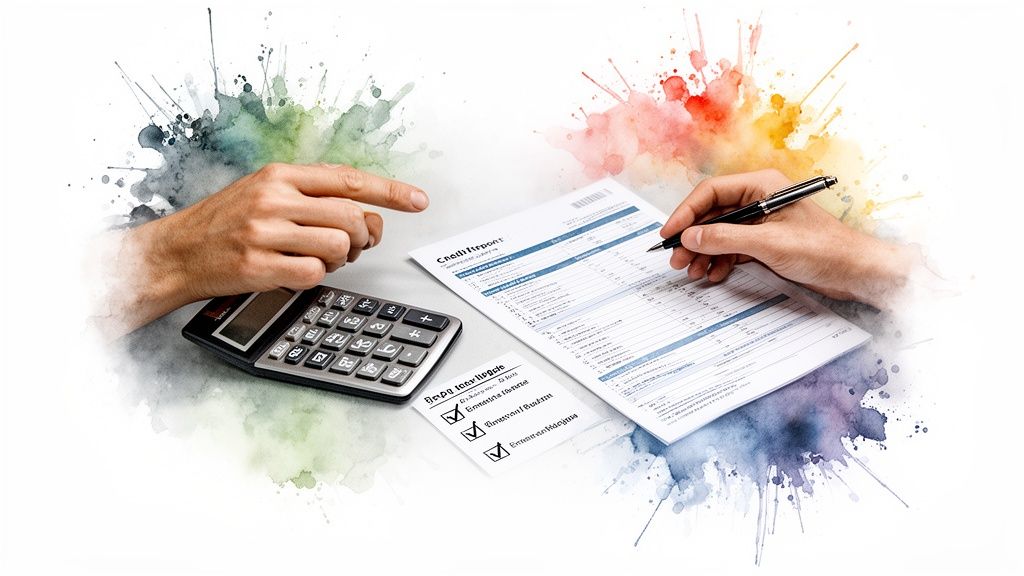
Before you jump into the comparison for a loan despite negative credit rating, take a deep breath. Now is the time for an honest cash check. This may feel uncomfortable at first, but it’s actually an incredibly powerful step. It gives you back control and transforms vague worries into a concrete plan.
The first and most important step on this path is to get clarity about the data that banks see about you. This means: You need your current Schufa credit report. Everyone has the right to request a free copy of their data once a year (in accordance with Art. 15 GDPR). Think of this overview as your personal financial cockpit – it contains all the relevant information in black and white.
To really understand your financial situation, it is essential that you have your current credit report to hand. Find out how you can apply for your Schufa report online easily and without stress – this is the basis for everything that follows.
Read and understand the Schufa entry correctly
As soon as you have the information in front of you, it’s time to interpret it. Because not every entry is the same. There is a huge difference between so-called “soft” and “hard” negative features.
- Soft characteristics: These include, for example, a canceled credit card or an installment loan that was once canceled but has since been repaid in full. Such entries are not ideal, of course. But many banks view them less critically, especially if it’s been a while.
- Hard features: This is where things get serious. These include an arrest warrant to enforce an affidavit, ongoing insolvency proceedings or titled claims that are still outstanding. Such entries make a loan application with traditional banks practically hopeless.
Really take your time and check every single point in your credit report. It happens more often than you think that mistakes creep in that unnecessarily drag down your credit rating.
A classic case is outdated entries that should have been deleted long ago. If, for example, a settled claim still appears after the three-year period has expired, you have the right to have it corrected. This alone can significantly improve your score.
The budget bill: the moment of truth
However, your Schufa score is only one side of the coin. Your ability to service your debt is at least as important. Put simply, how much of a loan installment can you afford each month? A simple but brutally honest budget calculation is worth its weight in gold here.
Sit down and list everything that comes in and everything that goes out. Be ruthless with yourself.
Your income could include:
- Net salary or wage
- Income from self-employment
- Child benefit, parental benefit
- Rental income
Their expenses are often more varied:
- Rent and ancillary costs
- Electricity and heating
- Food and everything for the household
- Costs for car or public transport
- All insurances
- Current installments for other loans or financing
- Subscriptions (streaming, gym, etc.)
- Private expenses for hobbies and leisure
The difference that remains at the end is your monthly surplus. This is the absolute upper limit for a possible loan installment. However, a healthy buffer for unforeseen expenses should definitely be deducted from this. This figure is often more convincing for lenders than a perfect Schufa score. If you want to delve deeper into the subject, our guide to creditworthiness will provide you with further important details.
This thorough preparation will not only protect you from over-indebtedness. You will also strengthen your negotiating position. You won’t come across as a supplicant, but as someone who has their finances under control and plans responsibly.
Practical strategies for your loan application

Okay, you’ve checked your finances and know where you stand. Now it’s time to get down to business: developing a clear strategy for your loan despite negative Schufa. Simply sending out wild requests usually doesn’t achieve anything except further rejections. A targeted approach is now the key to success.
The main aim here is to give the bank what it is missing due to the Schufa entry: security. You need to prove that you are a reliable borrower despite your past. There are a few tried and tested methods that can drastically improve your chances of being approved.
Stronger together with a second borrower
One of the best cards you can play is to have a second person in the loan agreement. This could be your partner, a parent or a good friend with a solid credit rating. This is a real game changer for the bank. The risk is halved virtually overnight because suddenly two people are responsible for repayment.
Imagine this: You alone apply for €20,000. With your income and the Schufa entry, all the warning lights go on at the bank. But if your partner joins you, who has a secure income of their own and a clean credit rating, the world looks completely different. The bank now takes the entire household income into account and the responsibility is shared.
The result? Not only a much higher probability of a “yes”, but often also significantly better interest rates. The only important thing is to discuss this step openly. Both parties must understand that they are liable for the full amount in the event of an emergency. Incidentally, you can find more tips and tricks for a successful loan application in our guide, which are worth their weight in gold when preparing.
The guarantor as a security anchor for the bank
A similar, but legally somewhat different variant is the surety. Here, a person with an impeccable credit rating – the guarantor – steps in if you can no longer service your installments. The guarantor is therefore not directly involved in the loan, but acts as a kind of safety net for the bank.
Banks usually require a “directly enforceable guarantee”. This means that they can contact the guarantor directly as soon as an installment defaults without having to sue you first. This makes things extremely secure for the bank.
A guarantee is a huge vote of confidence. Only ask someone from your closest circle who you trust completely. Clarify all the details transparently and preferably in writing so that the relationship does not suffer as a result of this huge responsibility.
Using tangible assets as a convincing argument
Do you have tangible assets that belong to you? A debt-free car, a life insurance policy or perhaps even a paid-off property? These can serve as loan collateral and are often the most convincing argument for banks.
Let’s take the car: if your car is debt-free and still has a value of, say, €10,000, you can offer it as collateral for a loan of this amount. The bank keeps the vehicle registration certificate (registration certificate part II) as collateral. The risk for the bank is reduced to almost zero, which suddenly makes a loan possible despite a Schufa entry. But beware: if you don’t pay, the bank can sell the car.
Debt restructuring as a strategic new start
Sometimes the best way to get ahead is to start from scratch. Do you have several small, expensive loans? Is your overdraft constantly at its limit? Then debt restructuring may be the solution. This involves consolidating all your old debts into a single, new loan – ideally with better conditions.
This move has several advantages:
- You save money: expensive old loans or overdrafts with interest rates of often over 10% are replaced by a cheaper installment loan.
- You gain an overview: Instead of paying five different creditors, you only pay a single installment to one bank. This creates order.
- You polish up your credit rating: Successful debt restructuring shows Schufa and other banks that you are actively taking control of your finances. This can improve your score in the long term.
A negative Schufa entry doesn’t make it easy, but it’s not a knock-out criterion. Specialized providers and comparison portals know that there is often more behind the numbers. Thousands of people have already received suitable loan offers despite their entry, which shows that a blanket rejection does not have to be the last word.
Credit strategies compared with negative schufa
Each strategy has its own strengths and weaknesses. This table will help you to quickly recognize which path might be best suited to your personal situation.
| Strategy | Advantages | Disadvantages / Risks | Ideal for… |
|---|---|---|---|
| Second borrower | Very high chances of success, often better interest rates. | Both are fully liable, requires great trust. | Couples or close family members who are planning a purchase together. |
| Guarantee | Significantly increases the chances of obtaining a loan. | Great responsibility for the guarantor, can strain relationships. | People with a reliable, creditworthy supporter among friends or family. |
| Security in kind (e.g. car deposit) | Quick approval possible, Schufa score less relevant. | Risk of loss of value (e.g. car), high interest rates possible. | Loan seekers who own a valuable, unencumbered item and need short-term liquidity. |
| Debt restructuring | Better overview, lower monthly installment, can improve credit rating. | Not always easy to find a provider, possible early repayment penalty. | People with several expensive old loans or an overdrawn overdraft facility who want to reorganize their finances. |
Take a moment to weigh up the options. The right choice depends entirely on your personal circumstances, the collateral available and the people around you.
Real alternatives to the classic bank loan
If the house bank finally says “no”, this is a damper at first, but by no means the end of the story. Quite the opposite. This is when the real, clever search for financing options begins that do not work according to the rigid, often outdated criteria of traditional banks. There is a whole market of reputable options that have been created precisely for such situations.
The best-known solution is the so-called “credit without Schufa”. These loans often come from banks in other European countries, such as Switzerland or Liechtenstein. The trick here is that these institutions do not carry out a Schufa check in Germany and instead focus almost exclusively on what really counts: Your regular, attachable income.
Loans without Schufa from abroad
The principle behind these loans is actually quite simple. The foreign bank looks at your creditworthiness, but with different eyes. A fixed, permanent employment contract and an income that is above the seizure-free limit – these are the decisive door openers here. Your German Schufa score? Doesn’t matter at the moment.
Of course, this flexibility comes at a price. As the bank takes on a higher risk of default, this is naturally reflected in the interest rates. You have to understand that a loan despite negative Schufa can be a real opportunity, but you have to check the conditions carefully. The Schufa score, which reflects your statistical probability of payment between 0 and 100, is the central tool used by German banks. If the score falls below 95 points, the red light goes on for many. This results in rejections or significantly higher interest rates. If you want to delve deeper into the matter, you can find more details on the risks and opportunities on the VR Banken information page.
You should always check the seriousness of such offers. There are a few clear warning signs that should make you prick up your ears immediately:
- Upfront costs: No reputable provider charges money before the loan has even been paid out. Never.
- Unrealistic promises: Slogans such as “Credit for everyone, guaranteed!” are pure bait and are dubious. A credit check is always carried out.
- Additional contracts: If you are urged to quickly take out residual debt insurance or a building society savings contract, this is a very bad sign.
P2P loans: money from person to person
P2P loans, or peer-to-peer loans, are an increasingly popular alternative. Here you don’t borrow money from an anonymous bank, but from private investors via an online platform. The huge advantage of this? The decision is often much more human and holistic.
You present your project on these platforms – whether it’s the restructuring of an expensive old loan or the financing of important further training. Private investors take a look at your project and decide whether to entrust you with their money. A negative Schufa entry is also visible here, but it is rarely the sole knock-out criterion. An honest, convincing description of your plan can make all the difference here.
P2P platforms often look at the big picture. A long-since cleared Schufa entry in combination with a stable job and a reasonable financing request is often viewed much more positively here than by a pure bank algorithm. Here you have the chance to tell your story.
Mini loans for short-term bottlenecks
Sometimes you don’t need a huge sum of money. You just need to pay an unexpected bill or close the gap until your next salary. Mini loans were invented precisely for these cases. We’re talking about small loans, typically between €50 and €1,500, with very short terms of 30 to 90 days.
The whole process is usually completely digital and lightning fast – the money is often in your account on the same day. Many providers of mini loans do take a look at your credit rating, but their assessment is much more relaxed than with a traditional installment loan.
But caution is advised here: The interest rates for the loan alone are often fair. The optional extras make it more expensive. Express payment or the option to pay in two installments can quickly drive up the costs. Mini loans are an ingenious solution for clearly defined, short-term needs. However, they are absolutely unsuitable for financing larger purchases or solving basic money problems. You can find out more about mini loans as a flexible financial solution in our guide.
Each of these alternatives has its own strengths and weaknesses. The key to success lies in finding exactly the option that suits your personal situation, your needs and your financial means. A close look at the conditions is essential to avoid jumping from the frying pan into the fire.
Reaching your goal safely and transparently: the application process step by step
You have explored your options and have a strategy in mind – perfect! Now it’s time to implement it. A well-prepared loan application is essential to maximize your chances of approval, especially if your credit rating is not completely clean. Let us navigate you through the decisive phases together, from the initial inquiry to the contract.
There’s one thing you need to internalize right from the start: the small but subtle difference between two terms that are often confused but have completely different consequences.
Condition request vs. credit request: the one trick that changes everything
Imagine you go to ten different car dealerships and ask for the price of a particular model. Perfectly normal, right? But if you submit a fixed loan application to ten banks in succession, it’s a bit of a disaster for your credit rating.
- The condition request (your creature-neutral joker): This is your window shopping, so to speak. You are signaling: “Hey bank, show me what conditions you could offer me in principle.” Although this request is noted at Schufa, it is invisible to other banks for a full 12 months. You can therefore compare offers in a relaxed manner without affecting your score.
- The credit application (the point at which things get serious): This is the binding, final announcement. You are clearly saying: “I would like to apply for this loan now.” Other banks will see this request immediately. If you make several of these in a short space of time, the banks’ alarm bells will start ringing. They then think you are in trouble or have already been rejected several times – and your score can plummet.
So the golden rule is: Always submit a condition request first! Reputable comparison portals such as Finanz-Fox work exclusively with this credit-neutral procedure. This allows us to find the best offers for you without damaging your credit rating.
Your checklist for the documents: Well prepared is half the battle
Nothing is more frustrating than a process that comes to a standstill because a document is missing. If you have everything ready from the outset, things will run like clockwork. It’s best to have the following documents ready digitally:
- Proof of income: The last two or three payslips are usually sufficient.
- Bank statements: The statements for the last one to three months, clearly showing the salary received. Without gaps, please!
- Proof of identity: A valid identity card or passport (in the case of the latter, you will also need a registration certificate).
- Employment contract: Sometimes the bank also wants to see a copy of your permanent employment contract.
- Tax assessments: For the self-employed, the last one or two income tax assessments are often the be-all and end-all.
With this stack of documents, you are ideally equipped and speed up the entire process enormously. You can also find more details and practical tips in our comprehensive guide to the credit process.
The digital way to a loan: quick, easy, convenient
Fortunately, the days when you had to lug thick folders to the bank to get a loan are over. Nowadays, almost everything is digital – fast, transparent and surprisingly uncomplicated.
You can play through various scenarios from the comfort of your couch. Simply adjust the loan amount or term and immediately see how the monthly installment changes. In no time at all, you’ll find a loan that really suits you and your budget.
As soon as you have discovered a suitable offer via a condition inquiry, it’s just a few clicks to your destination:
- Identify online: Going to the post office is a thing of the past. Today, you can easily prove your identity using the video identification process. Hold your ID card up to the webcam, a friendly member of staff briefly confirms your identity – and you’re done in just a few minutes.
- Sign digitally: Today, contracts are also signed digitally. With a qualified electronic signature (QES), this is legally secure and child’s play. One click or entering a TAN is all it takes.
These modern processes not only make borrowing faster, but also give you full control at all times. So you can concentrate on what really matters: finding the right financing for your project.
Questions that we are asked again and again
A loan despite negative Schufa? This naturally raises a lot of questions. No wonder, because there are many myths and unfortunately also a few pitfalls in this area. We have answered the most important questions from our experience for you here so that you can feel safe on your way and no uncertainties remain.
Which banks are most likely to work?
There is no fixed “yes” or “no” list for banks, as the internal rules of the game change too often. In practice, however, a clear trend can be identified: Specialized loan providers and often banks from other European countries, such as Switzerland or Liechtenstein, are usually more flexible. They look less at old Schufa entries and instead place more value on your current, attachable income.
For these providers, it’s the overall package that counts. A permanent, secure job can often outweigh an old entry that has long since been closed. Your traditional house bank around the corner is usually much stricter – requests with negative characteristics often result in an automated rejection.
This is precisely the great advantage of credit brokers such as Finanz-Fox. We submit a single, credit-neutral condition inquiry for you and use it to compare the criteria of numerous partner banks. This greatly increases your chances of being approved and at the same time protects your Schufa score from unnecessary credit inquiries.
How can I recognize black sheep?
When it comes to money in difficult situations, dubious providers are unfortunately not far away. But don’t worry, with a little common sense you can quickly unmask them. If these alarm bells ring, you should keep your distance immediately:
- Fees in advance? Never! Is someone asking for money to apply, check or send documents before you’ve even seen a penny? That is an absolute no-go. Reputable partners only receive their commission once the loan has been successfully disbursed.
- Additional contracts as a condition: Are you being pressured to quickly take out an expensive insurance policy, a building society savings contract or financial advice? Be extremely careful! A fair loan doesn’t need any extras.
- Unrealistic guarantees: Advertising slogans such as “Credit approval for everyone, score doesn’t matter” are pure bait and switch. A credit check always takes place, even if the criteria are different. Nobody gives money away.
- Lack of transparency: All costs, especially the APR, must be crystal clear on the table. If there is no legal notice on the website or the terms and conditions are gibberish, you should keep your hands off it.
Does a second borrower really bring that much?
Yes, and enormously so. A second borrower with a clean credit rating and a fixed income – a spouse or partner, for example – is the best security there is for the bank. The risk of default is practically halved, because from now on two people are liable for repayment with their full income.
The bank almost always rewards this significantly lower risk with a much higher probability of approval. In many cases, you will even get significantly better interest rates than you ever could on your own. To be honest, this is one of the most effective and fairest methods of getting a loan on fair terms despite your own negative entry.
Can I simply have a schufa entry deleted?
Unfortunately, this is only possible in exceptional cases. Premature deletion is only an issue if the entry is demonstrably incorrect, incomplete or outdated. A good example: You had an outstanding invoice for less than 1,000 euros, but paid it within six weeks. If the creditor reports this to Schufa, the entry can disappear immediately. Even if the data is obviously incorrect, you are of course entitled to have it corrected immediately.
Correct entries, on the other hand, remain there, even if they are negative and have long since been paid for. Legal retention periods apply here, which usually end exactly three years after the matter has been settled. So don’t fall for dubious offers that promise a “paid deletion” of correct entries – this is dubious and does not work. The very first step is and remains to obtain a free copy of your data from Schufa to check for errors yourself.
Do you think a loan despite negative credit rating could be the right solution for you? At Finanz-Fox, we are at your side. We compare the offers from our partners for you and together we will find a solution that really suits your life situation. Start your non-binding and credit-neutral loan application now at https://www.finanz-fox.de.
Article created using Outrank