Is it really worth paying off a car loan earlier? The short and clear answer from my experience is: Yes, in the vast majority of cases this is a clever move for your wallet. Even if the bank charges a small fee, the bottom line is that you often save several hundred euros in interest – and regain a good deal of financial freedom.
The financial benefits: How early redemption pays off
A car loan often feels like a burden on your leg, tugging at your budget month after month. Sure, the idea of getting rid of this burden sooner is tempting. But it’s not just about the good feeling. It’s about hard cash. The biggest leverage is the significant interest savings. Every euro you pay off early is a euro that the bank can no longer collect interest on.

An example from practice
Let’s make it concrete. Imagine you took out a loan of 20,000 euros for your dream car four years ago. The conditions: 72-month term, 6.99% effective annual interest rate. This results in a monthly installment of around 339 euros.
After 48 installments paid, there is still a remaining debt of 7,585 euros on the books. If you simply let the loan continue, interest of 547 euros would be added on top over the remaining 24 months. However, if you now repay the amount in one go, the bank will charge a so-called early repayment fee. However, this is capped by law and in this case only amounts to 76 euros (1% of the remaining debt).
The math is simple: 547 euros in interest saved minus 76 euros in fees equals a net profit of 471 euros! Money that you can get back just like that.
The trick is to offset the interest savings against the early repayment penalty. The savings are almost always significantly higher.
What does this mean for your everyday life?
Early repayment not only gives you a financial buffer, but also noticeably more flexibility in everyday life. Without the monthly installment, you suddenly have more leeway. You can use the money for your next vacation, as a nest egg or for a new purchase.
Another, often underestimated advantage: you get the registration certificate part II (the old “vehicle registration document”) back from the bank immediately. This means that the car is 100% yours and you can dispose of it freely – for example, if you want to sell it.
Early redemption at a glance
This table summarizes the key financial aspects of early loan repayment in order to provide a quick basis for decision-making.
| Aspect | Description | Example (based on the scenario) |
|---|---|---|
| Potential savings | Interest that no longer accrues for the remaining term. | 547 euros for the remaining 24 months. |
| Costs incurred | Early repayment penalty, limited by law to 1% of the residual debt. | 76 euros (1 % of 7,585 euros residual debt). |
| Net profit | The difference between the interest saved and the fee. | 471 Euro |
As you can see, the decision to end a loan early almost always makes financial sense. For more details on various car loans, you are welcome to read our further articles.
What will early repayment cost me? The early repayment penalty in plain language
The word “early repayment penalty” alone sounds complicated and like an expensive pitfall. Many people are reluctant to get rid of their car loan early because they fear high penalties. But let’s take the fear out of this term together. The truth is that the whole thing is not that complicated and is clearly regulated by law.
Just imagine it like this: The bank has firmly counted on the interest income over the entire term when the contract was concluded. This is part of their business model. If you suddenly pull out of the contract earlier and repay everything in one go, the bank loses part of this calculated profit. The early repayment penalty is therefore nothing more than compensation for this lost interest.
Fortunately, the bank cannot simply demand whatever it wants. The legislator has set a clear upper limit to protect us as consumers.
Your protective shield: the 1 percent rule
The German Civil Code (§ 502 BGB) clearly defines the framework for this compensation for consumer loans – and this includes your car loan. This rule is your most important ally and is very easy to understand:
- If the remaining term of your loan is more than 12 months, the bank may demand a maximum of 1% of your outstanding debt as compensation.
- If there are even less than 12 months until the end of the contract, this rate drops to a maximum of 0.5% of your remaining debt.
This statutory cap makes the costs absolutely calculable for you. In the vast majority of cases, the savings from the elimination of interest are significantly higher than this small fee.
Very important: The early repayment penalty must never be higher than the interest you would have paid over the rest of the loan anyway. So the bottom line is that you never pay more, you always save.
Let’s do the math
Theory is all well and good, but what does that mean in concrete terms in euros and cents? Let’s take a look at two typical scenarios to give you a feel for what you could be facing.
Example 1: Still a while to go until the end of the contract
Let’s assume you still have a remaining debt of 10,000 euros and the loan would actually run for another 18 months.
- The remaining term is more than one year, so the 1 percent rule applies.
- The bank may therefore charge you a maximum of: €10,000 x 0.01 = €100.
These 100 euros are offset by the interest savings for the entire 18 months – which will almost always be significantly higher.
Example 2: On the home straight
Now let’s imagine that your remaining debt is only 4,000 euros and you would be finished in 8 months anyway.
- The lower 0.5 percent rule applies here, as the term is less than one year.
- The maximum fee would therefore be: €4,000 x 0.005 = €20.
To be honest: with a fee of 20 euros, early redemption is almost always worthwhile, even if the remaining interest burden is no longer huge.
How to get the exact transfer amount from your bank
Your own rough estimate is a great first step. For the transfer, however, you need the exact, binding amount from your bank. Fortunately, requesting this is not a big deal.
You usually have several options to choose from:
- The quick call: Simply call your bank’s service hotline. Have your loan agreement number to hand and ask for the redemption amount on a specific date, for example in a week’s time.
- Convenient online banking: Many modern banks have a function in the customer portal that allows you to request a loan balance or a redemption calculation with just a few clicks.
- The classic way: An informal letter by e-mail or post also works, of course. Simply ask for a precise breakdown of the remaining debt plus the prepayment penalty.
Your bank is legally obliged to provide you with this information. You will then receive an official document stating the exact amount you need to transfer to clear the loan once and for all. If you are interested in the topic in general, you can find more information about the different types of fees that can be incurred in the financial sector in our related article.
As you can see, the early repayment penalty is not an insurmountable obstacle, but a fair and manageable amount. Once you understand the calculation, an initial worry turns into a simple item on your bill – on the way to financial freedom. You stay in control and make a smart, informed decision.
Your roadmap to successful loan repayment
So you’ve decided to get rid of your car loan early. A great decision! Now it’s just a matter of getting the whole thing off to a good start. I’ve put together a tried-and-tested roadmap for you so that you don’t experience any nasty surprises along the way. Don’t think of it as a rigid set of instructions, but rather as a guide to navigate you safely through the process.
Sure, the idea of finally being debt-free is inspiring. But before you pick up the phone full of enthusiasm, good preparation is half the battle. Without the right information and documents, things can otherwise quickly become unnecessarily tough.
The first step: preparing and contacting the bank
Before you send an e-mail or wait on hold at the bank, you should briefly gather your documents. This not only saves time, but also shows the bank that you know exactly what you want.
It is best to have the following ready:
- Your loan agreement: This contains all the important key data – contract number, original loan amount, interest rate.
- The current repayment plan: If you have one, this is perfect for getting a quick overview of the remaining debt.
- Your personal data: Customer number and everything the bank needs for identification.
As soon as you have everything ready, you can contact the bank. Whether by phone call, message in online banking or informal e-mail is up to you. However, make your request very clear: you want to know the exact transfer amount on a fixed date, for example in a week’s time.
It is important that you explicitly ask for a statement showing the remaining debt and the early repayment penalty separately.
This graphic shows quite simply how the bill is made up for you in the end.
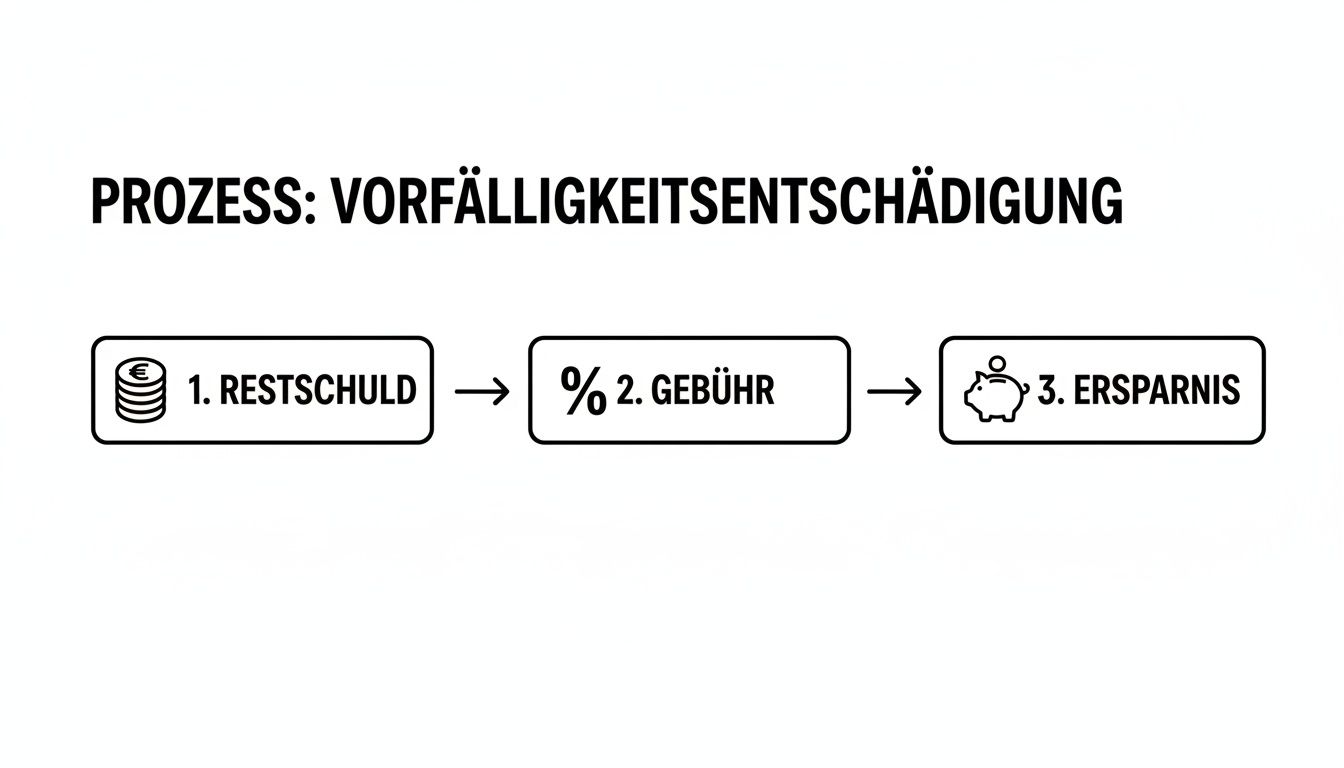
You can clearly see that a small fee is deducted from the residual debt, but the savings that remain at the end are usually considerable.
The bank’s offer: it’s worth taking a closer look
A few days later, the official letter from the bank arrives. Now take a coffee and examine the document at your leisure. This figure is the basis for everything else.
Are the figures correct? Compare the residual debt mentioned with your own documents. Is that about right? You should pay particular attention to the early repayment penalty. With the 1 percent rule in mind, you can quickly estimate whether the bank is adhering to the legal limits. If anything seems strange, ask immediately.
A critical look at the transfer offer is mandatory. Where people work, mistakes happen. A brief but firm inquiry can save you money in the end.
Financing: your own money or a new loan?
If the figures fit, the crucial question is: where will the money for the transfer come from? There are basically two ways.
- Repayment from savings: the easiest and cheapest way. If you have the money on the high edge – whether through a bonus, an inheritance or simply good savings – you can transfer the sum directly.
- Repayment through debt restructuring: Not everyone just has the money lying around. Debt rescheduling is often a clever alternative. You take out a new, cheaper loan with another bank to pay off the old, expensive car loan in one go. This is particularly worthwhile if interest rates have fallen since you originally took out the loan.
If debt restructuring is an option for you, it’s best to take a look at a few tips and tricks for a successful loan application.
The final act: termination and conclusion
As soon as the financing is in place, it’s time for the final step: the termination. A simple letter is all you need. To make it even easier for you, I have prepared a sample letter here that you just need to adapt.
Sample letter for terminating your car loan
[your name]
[your address]
[zip code town]
[name of bank]
[address of bank]
[zip code town]
[Place], [Date]
Subject: Early repayment of my car loan, contract number: [your contract number]
Ladies and Gentlemen,
I hereby cancel my above-mentioned car loan in due time as of [date of redemption].
I will transfer the transfer fee in the amount of [amount] € communicated by you on [date of offer] to the account specified by you in due time.
Please confirm receipt of the notice of termination and payment in writing. I would also ask you to send me the registration certificate part II (vehicle registration document) for the vehicle with the chassis number [your chassis number] to my above address immediately after the redemption has been completed.
Thank you very much for your efforts.
Yours sincerely,
[Your signature]
[Your name]
After you have transferred the money, keep the receipt in a safe place. The bank will confirm receipt of payment and then comes the big moment: it will send you the registration certificate part II, the vehicle registration document. Only when you have this important document in your hands does the car really belong to you and the deal is finally closed.
Debt restructuring as a smart alternative
Not everyone has the entire remaining amount for their car loan in their current account – and that’s completely normal. If you still want to get out of an expensive, old loan agreement, there is a pretty clever strategy: debt restructuring. The whole thing becomes a financial bull’s eye, especially if the interest rates on the market are currently significantly lower than what you signed up for at the time.

Basically, it’s quite simple: you take out a new, cheaper loan to pay off the old, more expensive one in one go. In other words, you are exchanging an old financial burden for a new one with significantly better conditions.
When debt restructuring really makes sense
Debt restructuring is not a panacea, but it is a brilliant move in certain situations. The be-all and end-all is the interest rate differential. Perhaps you took out your car loan during a high-interest phase and interest rates have fallen significantly since then? This is exactly when an interesting savings potential opens up for you.
Imagine your old loan is running at 6.5% interest. But when you do a quick search, you suddenly find offers for installment loans at just 3.5%. This is the moment when alarm bells should start ringing. Even if you deduct the early repayment penalty for the old loan, the savings from the lower interest rates over the remaining term can be enormous.
The golden rule is: the interest savings from the new loan must significantly exceed the cost of repaying the old loan (i.e. the early repayment penalty).
A concrete scenario from practice
Let’s take an example. Mr. Meier still has a remaining debt of €12,000 on his car loan. The contract runs at 7% interest and has 36 months to run. His monthly installment is around €370.
Now he finds a debt restructuring offer for €12,000 – also with a 36-month term, but at a top interest rate of just 3.8%.
Let’s take a closer look at the figures:
- Repayment amount for the old loan: €12,000 remaining debt + €120 early repayment penalty (1%) = €12,120.
- New loan: Mr. Meier must therefore take out a new loan of €12,120 to pay for everything.
- New monthly installment: His new installment is now only around € 355.
- The result: not only does he immediately save €15 per month, but his total interest costs over the remaining term are reduced by more than €500. A nice bonus!
The right choice for a debt rescheduling loan
If you are thinking about debt restructuring, a careful comparison is absolutely crucial. It’s not just about finding the lowest interest rate. Pay attention to the overall package. For example, a good debt rescheduling loan should allow for free unscheduled repayments. This way, you remain flexible if money unexpectedly comes in in the future.
Modern digital processes make your life much easier today. A streamlined, fast online application process, as you can find on comparison platforms, saves you a trip to the bank branch and delivers suitable offers in just a few minutes. Take a look at our guide on how to compare loans made easy.
What role does SCHUFA play in debt restructuring?
Of course, your creditworthiness is also the key to good conditions for debt restructuring. A loan application to a new bank will result in a SCHUFA entry. It is very important here: Make sure that the bank only makes an “inquiry about credit conditions”. This is SCHUFA-neutral and will not worsen your score, even if you obtain several offers. Only the actual conclusion of the new contract will be noted as a binding loan application.
A good SCHUFA score signals to the new bank that you are a reliable borrower. This is usually rewarded with a better interest rate.
Debt rescheduling vs. repayment from own funds
Both paths lead to the goal, but which one suits you better? That depends entirely on your personal financial situation.
| Aspect | Replacement from own funds | Debt rescheduling |
|---|---|---|
| Advantage | You are immediately completely debt-free, have no new liabilities and save a maximum of interest. | Your liquidity and nest egg remain untouched, you benefit from lower interest rates and can reduce the monthly installment. |
| Disadvantage | Your savings are gone and may not be available for other important purchases or emergencies. | You remain in debt, albeit at better conditions. A good credit rating is a prerequisite. |
| Ideal for | People with sufficient savings who want to get rid of financial burdens for good. | People without large reserves who would like to reduce their monthly charges and save interest in the long term. |
Debt restructuring is therefore a powerful alternative for regaining control of your finances without having to sacrifice all your savings. This is an important lever, especially in times when many are financially challenged. The rising level of over-indebtedness in Germany shows how important it is to actively reduce financial burdens. According to the Creditreform Debtor Atlas, 5.67 million people are currently over-indebted, which corresponds to an increase of 2.0 percent compared to the previous year – the first increase since 2018. Find out more about the background to the current debtor trend in Germany at creditreform.de.
Clever replacement: How to avoid typical mistakes and really save money
There are a few stumbling blocks on the way to a debt-free car that can end up costing you money. Repaying a car loan early is usually a really clever financial move, but only if you know the pitfalls and avoid them with confidence. I know from experience that it’s often small carelessness that makes the difference between a good and an optimal redemption.
The prospect of finally getting rid of the monthly installment is simply too tempting. However, it’s easy to overlook important details. An unprepared conversation with the bank or a miscalculated saving can quickly put a damper on the joy. That’s why I’ve compiled the most common mistakes for you – so that your path to a debt-free car runs smoothly.
Ignore the perfect time
Many people think: the sooner I pay off the loan, the better. This is basically true because of the interest savings, but timing is everything. A classic mistake is to rush into paying off the loan without considering your overall financial situation.
Imagine you scrape together all your savings to get rid of the loan. Just a few weeks later, the washing machine goes on strike. Suddenly your nest egg is missing and, in the worst case, you have to use your expensive overdraft facility.
My practical tip: Only pay off the car loan when you have a financial cushion – i.e. at least three net monthly salaries – that remains untouched. The interest savings are quickly lost if you have to borrow expensive money for unforeseen expenses.
Incorrectly estimating the early repayment penalty
Another classic example: incorrectly estimating the early repayment penalty. Some people don’t expect it at all, others assume that the amount is far too high and quickly discard the idea of paying it off. As we have already discussed, this fee is capped by law at a maximum of 1% of the remaining debt.
Be clear: this fee is a calculable item that only slightly reduces your overall savings. The real mistake is to be put off by the term instead of simply including it soberly in your own calculation.
Overlook the small print in the redemption offer
When the bank’s redemption offer arrives in your letterbox, your eyes usually jump straight to the final amount. But, as is so often the case, the devil is in the detail. A critical second look is worth its weight in gold here.
Pay very close attention to these points:
- Key date for the calculation: The sum stated is only valid up to a certain date. If you transfer too late, the amount may have changed again.
- Separate items: Is the residual debt clearly listed separately from the early repayment penalty? This is the only way you can understand the bank’s calculation.
- Hidden fees: Even if pure processing fees are inadmissible, you should check whether other, questionable items appear on the statement.
Take the time to review the letter at your leisure. If you want to delve deeper into the subject, you can find everything you need to know about installment loans in our article on the art of financing.
Do not actively reclaim the vehicle registration document
This is perhaps the most important point after the money has flowed: you have transferred the entire sum, the loan has been repaid – but you hear nothing from the bank. The vehicle registration certificate, i.e. the registration certificate part II, is still in the bank’s vault as collateral.
Don’t rely on this important document automatically finding its way to you. Many borrowers simply forget to actively initiate the return.
This way you play it safe:
- Request in writing: In your letter of termination (as shown in our sample letter), ask the bank to send you the vehicle registration document as soon as payment has been received.
- Actively follow up: If you still haven’t received the document after about two weeks, call or write a short e-mail.
- Keep the confirmation: Keep the bank’s written confirmation of the loan repayment and receipt of payment in a safe place.
Only when you have the vehicle registration document back in your hands is the process really complete and the car is 100% yours.
The most frequently asked questions about early redemption
If you’re thinking about getting rid of your car loan earlier than planned, there are often a lot of questions buzzing around in your head. That’s completely normal – after all, it’s an important financial decision that you don’t want to get wrong. From my experience, I can say that there are always the same typical uncertainties. I have collected the most important ones for you here and answered them in a very practical way.
Can the bank prohibit me from early redemption?
I often hear this concern, but I can reassure you: With a classic installment loan, as is the rule with car financing, the bank is not allowed to refuse you early repayment. This right is guaranteed to you as a consumer by law.
What the bank can – and usually does – do is demand an early repayment fee. This is financial compensation for the interest it loses as a result of your earlier repayment. However, a complete refusal is practically impossible with these contracts.
What is the difference to a special repayment?
There is often confusion here, although the two terms describe something completely different. Think of it like this:
A special repayment is like an additional installment payment. You transfer an extra amount that is deducted directly from the remaining debt. However, the loan agreement continues as normal, just with a lower debt and often a shorter term.
Early repayment is the final step. You repay the entire remaining debt in one fell swoop, thereby terminating the loan agreement for good.
Remember: A special repayment only shortens the path, while early repayment is the goal. It ends the contract completely and makes you debt-free again immediately.
What documents do I need to collect for the replacement?
Good news: You don’t need a thick file folder. In most cases, a single piece of information is enough to get the process rolling: Your credit agreement number.
Keep this number to hand when you call your bank or write an e-mail. The bank already has all the other information, such as the exact remaining debt or the remaining term, in its system. The bank will then send you an official letter with the exact repayment amount and a deadline for payment.
Do I have to announce the replacement well in advance?
No, fortunately there is no notice period as with a rental agreement. You can inform your bank of your intention to pay off your car loan early at any time.
The process is very simple: you request the redemption amount, transfer the amount punctually on the specified date and that’s it. Just remember that the bank’s offer is usually only valid for a few days because the remaining debt changes minimally due to the daily interest calculation.
When will I finally get my vehicle registration document back?
As soon as your money is booked at the bank and the loan agreement is officially terminated, the bank must hand over the registration certificate part II (the vehicle registration document) to you. After all, it only served as collateral.
In practice, dispatch usually takes between one and two weeks. If the important document is still not in your letterbox after 14 days, I would simply make a friendly enquiry if I were you. Because only when you have the vehicle registration document in your hands again is the car legally 100% yours.
Are you ready to say goodbye to your expensive loan and enjoy more financial freedom again? At Finanz-Fox you will find transparent comparison calculators and personal advice to help you find the best solution for debt restructuring or a more favorable new loan. Start your no-obligation comparison now at finanz-fox.de and see for yourself how much you can save.