Buying a new car is a big deal – but financing it doesn’t have to be. A car loan calculator for Switzerland is your most important tool for creating clarity right from the start. With a few simple entries, you can immediately see what you can expect and which adjustments really make a difference.
How to find the car financing that really suits you
It’s not about finding just any loan. You need the one that fits seamlessly into your life and your budget. A solid plan not only gives you security, but also ensures that the new car remains pure joy without causing financial headaches.
The trick is to understand the interrelationships: Purchase price, down payment, term and interest rate – all of these factors play together and ultimately determine your monthly burden. A higher down payment, for example, not only lowers the loan amount, but often also gives you a better negotiating position for more favorable interest rates. On the other hand, a longer term may result in lower monthly installments, but you will pay more interest over the entire term. It’s a constant balancing act.
A transparent comparison, as made possible by kredit-vergleich.ch, is the be-all and end-all. This is the only way to avoid hidden fees and secure the best conditions the Swiss market has to offer.
Why you can’t avoid a credit comparison
The Swiss credit market is a jungle. The interest rates of the various providers can differ massively, and those who blindly rely on the offer from their house bank or car dealership often end up paying more. An independent comparison is the only way to get a real overview.
Many Swiss people have long since realized this. Did you know that more than half(55%) of all cars in Switzerland are financed through a loan or lease? This clearly shows that the classic cash purchase is no longer the norm. Most of us are dependent on external financing. You can find a fascinating insight into financing habits in Switzerland on blick.ch.
The key factors in the calculation of your car loan
Before you start the calculator, it is helpful to know how the individual entries affect your financing. Each value has a direct impact on your monthly installment and the total cost of your loan.
This table shows the most important input values for the car loan calculator and explains their direct influence on your monthly installment and the total costs.
| Input value | Input value Description | Effect on the monthly installment | Effect on the total costs |
|---|---|---|---|
| Purchase price | The total amount you spend on the vehicle, including all ancillary costs. | Higher purchase price = higher installment | Higher purchase price = higher total costs |
| Down payment | Your equity that you contribute directly to the purchase. | Higher down payment = lower installment | Higher down payment = lower total costs |
| Term | The period over which you repay the loan (in months). | Longer term = lower installment | Longer term = higher total costs |
| Interest rate | The effective annual interest rate, which includes all credit costs. This is the most important comparative figure. | Higher interest rate = higher installment | Higher interest rate = higher total costs |
If you understand these relationships, you can search for the right financing for you in a much more targeted way and make well-founded decisions.
This guide is designed to give you the tools you need to use the calculator with confidence and make the best financial decision for you. With the right knowledge, car financing becomes a transparent and completely predictable process. For even deeper insights, we have compiled detailed information on car loans for you in another article.
Feeding the car loan calculator correctly: how it works
A calculator is only as smart as the numbers you give it. For the car loan calculator in Switzerland to be a really useful tool for you, the entries must be correct. Look at it this way: the more precise your information, the more solid your financing plan will be in the end.
Purchase price: more than just the price of the car
The “purchase price” is almost never just the amount shown on the price tag at the dealership. Many people forget the crucial additional costs that can quickly blow the budget.
Think of everything from the start:
- Delivery fee: This is the dealer’s fee for preparing the car and the paperwork. Almost always incurred.
- Additional equipment: A set of winter wheels, a roof box or a trailer coupling? It all belongs in the total bill.
- Re-registration fees: Registration at the road traffic office also costs money and is part of the acquisition costs.
If you plan realistically, you can avoid expensive additional financing or nasty surprises.
The down payment as your strongest lever
A solid down payment is the best way to get started with affordable financing. It not only lowers the loan amount and therefore your monthly payment, but also sends a strong signal to the bank. With CHF 5,000 or more in equity, you demonstrate financial stability. This significantly improves your negotiating position for a good interest rate.
My tip from experience: Think of the down payment as an investment in lower overall costs. Every franc you put on the table right from the start does not have to be expensively financed over the years.
Term and interest rate: the decisive compromise
Finding the right term is always a balancing act. A long term of 72 or 84 months naturally makes the monthly installment pleasantly low, but at the end of the day you pay significantly more interest. Conversely, a short term puts a greater strain on your monthly budget, but saves you a lot of money in the end.
At the same time, the interest rate plays the main role. Don’t fall for bold “from” interest rates. The interest rate you actually get depends on your creditworthiness. Most Swiss providers work with interest margins that often range from around 4.9 % to 9.9 %. For an initial, honest calculation, it is clever to calculate with a value from the mid-range.
The path from the dream car to the finished financing plan can be easily visualized.
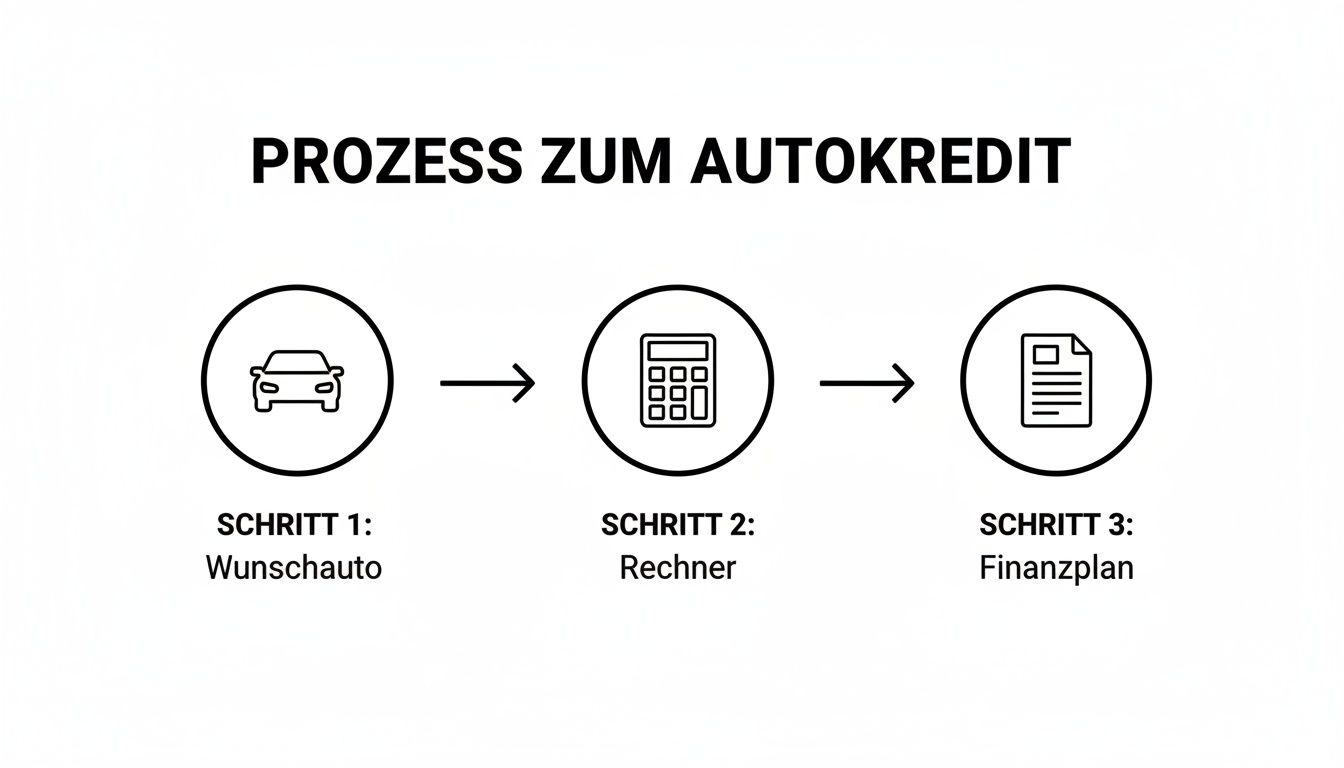
The computer is the crucial link that turns a dream into a feasible plan.
Let’s take a concrete example
Let’s imagine your dream car is a VW Golf for CHF 35,000. You bring CHF 5,000 as a down payment. That leaves you with CHF 30,000 to finance.
- Scenario 1 (short and sweet): With a term of 48 months and an assumed interest rate of 6.9%, you end up with a monthly installment of around CHF 717. The total interest costs amount to around CHF 4,416.
- Scenario 2 (long & comfortable): If you extend the term to 72 months, the installment drops to around CHF 510, but the interest costs rise to an impressive CHF 6,720.
The difference is striking: in this case, the longer term will cost you over CHF 2,300 more in interest. Be sure to play with different figures yourself. The loan calculator on our website is the perfect tool to get a feel for these relationships and find the best option for your personal situation.
Correctly interpreting the results of the car loan calculator
So, the figures are in the calculator and the result is in front of you. It’s a number in black and white. But what does it really mean for your wallet? The trick is not to generate the figures, but to translate them into a solid, realistic financial plan.
The first figure that catches the eye is, of course, the monthly installment. This is the amount that will be deducted from your account every month. But beware, this is where many people stumble: This installment is only half the truth, because it only covers the loan itself.

A car is more than just an installment. In order to know the actual monthly cost, you need to add the running costs:
- Insurance: Third-party liability is compulsory anyway. But with a new, financed car, you can hardly avoid fully comprehensive insurance.
- Taxes: Motor vehicle tax is a large item and varies massively depending on the canton and vehicle model.
- Maintenance & repairs: Plan money for servicing, tire changes and unexpected repairs. A buffer is worth its weight in gold here.
- Fuel or electricity: Calculate honestly how much you will spend per month on “refueling”.
Only when the sum of the loan installment and all these additional costs fits comfortably into your household budget can you sit back and relax. Then the financing is really affordable.
Keeping an eye on the total costs
Perhaps the most important value that the calculator spits out is the total interest costs. Here you can see what the loan will really cost you in the end. It’s amazing: an interest rate difference of just one percentage point sounds like little, but over a term of 60 months it can quickly make a difference of a thousand francs or more.
An independent comparison of different providers is therefore not an option, but simply a financial necessity. Never rely on the first offer that comes along.
The topic is becoming all the more relevant as the Swiss car market is developing strongly in the direction of electromobility. Battery-electric vehicles have already achieved a market share of 22.8 percent – and the curve is pointing steeply upwards. As these cars are often more expensive to buy, cleverly thought-out financing is becoming increasingly important.
Understanding how your credit melts away
Another point to understand is amortization – how your debt decreases month by month. Each installment you pay consists of two parts: an interest portion and a repayment portion.
- At the beginning of the term, the interest component is quite high because the remaining debt is still large. So you are mainly paying for the “loan fee” of the money.
- Towards the end of the term, the whole thing turns around. The interest portion becomes tiny and you almost only repay the actual debt.
This knowledge is enormously helpful. It not only shows you the monthly burden, but also the progress of how the mountain of debt is getting smaller until the car is finally yours. By the way, we have broken down exactly how the loan interest works for you in a separate article.
What you need to consider when financing a car in Switzerland
The Swiss credit market ticks according to its own rules. If you know them, you have a clear advantage. It’s not just about distinguishing between serious and dubious offers, but also about knowing your own rights and confidently negotiating the best conditions.
The ZEK: Switzerland’s financial memory
A central point in the Swiss system is the Central Office for Credit Information (ZEK). You can think of it as the country’s financial memory. Everything comes together here: Credit applications, existing contracts and, above all, your payment history as a private individual.
A clean ZEK report is your ticket to a good interest rate. It is important to know that every loan request is noted there. Too many requests in a short period of time can be interpreted negatively by banks – it looks as if you are desperately searching. This is precisely why a targeted comparison, as made possible by kredit-vergleich.ch, is worth its weight in gold.
The Consumer Credit Act protects you as a buyer
The Consumer Credit Act (CCA) is your protective shield for most car loans in Switzerland. It is designed to protect consumers from over-indebtedness and ensures fair, transparent rules on the market.
For you as a borrower, these points are particularly important:
- Strictly check your creditworthiness: No reputable provider will offer you a loan that exceeds your budget. This is prohibited by law.
- Statutory withdrawal period: You have 14 days after conclusion of the contract to change your mind and withdraw from the contract without giving reasons.
- Clear interest rate cap: The maximum permitted APR is capped by law. This is currently 12% for cash loans.
- Early repayment at any time: You can always repay your loan earlier than stated in the contract. You may not incur any penalties for this and the interest for the remaining term will be waived.
Compliance with these rules is closely monitored by the Swiss Financial Market Supervisory Authority (FINMA). This ensures a high level of security. If you want to delve deeper into the subject, you can find all the details in our article on the Swiss Consumer Credit Act.
Probably the biggest advantage of the KKG for you is its enormous flexibility. The option to make unscheduled repayments at any time free of charge or to pay off the loan completely gives you full control over your finances.
Car loan or leasing – what’s the catch?
This is the crucial question for almost every car buyer in Switzerland. Even if both ultimately lead to you driving a new car, the financial and legal differences are huge. Our car loan calculator Switzerland is designed for calculating a loan – a leasing calculator calculates quite differently.
| Feature | Car loan | Leasing |
|---|---|---|
| Ownership | The car is yours from day one. | You are only the user, the leasing company remains the owner. |
| Flexibility | No mileage limit, free choice of garage. | Strict mileage limit, often tied to brand workshops. |
| End of contract | After the last installment, the matter is settled. | You return the car – often followed by additional payments for damage. |
| Taxes | You can deduct debt interest from your taxable income. | Leasing installments cannot be claimed for tax purposes by private individuals. |
A car loan therefore gives you much more freedom and makes you the unrestricted owner. You alone decide when you sell the car, how many kilometers you drive it and where you insure it. With leasing, you only rent the vehicle for a certain period of time. At the end, you have to return it in a contractually defined condition, which often leads to expensive surprises at the end of the lease.
Practical strategies for optimizing your car loan
A car loan calculator in Switzerland provides you with the pure figures – but you can only get the really best financing if you take the reins into your own hands. With a few clever strategic steps, you can noticeably improve your conditions. In the end, you will save hundreds, if not thousands, of francs over the entire term. It’s about not just passively looking for a loan, but actively shaping your car financing.
One of the most effective measures is to maintain your credit rating. A clean ZEK entry is worth its weight in gold here. Regularly check what is stored about you. Do you find outdated or incorrect data? Then have it corrected immediately. It often helps to combine several small loans into one. This not only gives you a better overview, but also improves your creditworthiness in the eyes of the bank.
Use your legal advantages
The Swiss Consumer Credit Act (KKG) is on your side and gives you powerful tools. One of the most important: you have the right to make special repayments free of charge. This means that if you receive an unexpected bonus or have been able to put some money aside, you can use it to repay your loan more quickly. Each individual unscheduled repayment shortens the term and directly reduces the total interest costs.
A second borrower can be a clever option, especially for larger loan amounts or if your own credit rating is not perfect.
- Stronger together: If you conclude the loan agreement together with a partner who has a good credit rating, the risk for the bank is significantly reduced.
- Better interest conditions: Lenders often reward this reduced risk with a noticeably better interest rate.
- Higher credit limit: A second applicant can also significantly increase the chance of approval for a higher loan amount.
A decision like this can open doors to conditions that might have remained closed to you on your own.
The market situation as an optimization factor
Also keep an eye on current developments. The Swiss car market is currently at an all-time low with only 233,737 new registrations – a decline of 2.4 percent. This could reduce competition in the trade and drive up vehicle prices. You can find out more about this in the analysis of the current Swiss car market on auto-wirtschaft.ch. In such an environment, it is all the more important to calculate financing costs very carefully.
Your credit rating is not a fixed value. It is a dynamic value that you can actively influence. Good preparation and strategic planning are the key to securing the best possible credit conditions.
With these tried-and-tested tips, you don’t just use the calculator to compare figures. You create the best possible basis for your financing and ensure that your car loan is not only feasible, but also as affordable as possible.
Would you like to work specifically on your financial situation? In our guide, we show you how to improve your credit rating in Switzerland.
Frequently asked questions about the car loan calculator in switzerland
Anyone thinking about financing a car quickly comes up against the same central questions. A car loan calculator for Switzerland provides the bare figures, but it takes more than that to get a really good gut feeling when making a decision.
Here we shed light on the darkness and clarify the typical uncertainties. So you can start your financing project well informed.
What documents do I need for a car loan in switzerland?
Good preparation is the be-all and end-all for a smooth loan application. Reputable Swiss banks carefully check your creditworthiness and require a number of standard documents.
It is best to have the following documents ready:
- Valid ID: A clean copy of your identity card (both sides) or passport.
- Residence permit: If you do not have Swiss citizenship, the bank needs a copy of your permit (B, C or G permit for cross-border commuters).
- Proof of income: As a rule, these are the payslips for the last three months. This proves that you have a stable, regular income.
- Extract from the debt collection register: Many providers require a current extract (not older than three months) in order to be able to assess your payment behavior.
Depending on the loan amount or your personal situation, the bank may also request additional documents. But one thing is certain: complete and proper documentation speeds up the whole process enormously.
Can I get a car loan despite debt collection?
We often hear this question, and unfortunately the answer is usually sobering. An open or recently completed debt collection is a clear negative feature that is stored at the ZEK (Central Office for Credit Information). This sets alarm bells ringing for every bank – the risk of default is considered to be very high.
Institutions that are subject to the strict Consumer Credit Act – and these are all reputable providers – will almost always reject a credit application in the event of ongoing debt enforcement. My urgent advice: get your finances in order first and have the entry deleted before you start a new attempt. Anything else is usually wasted effort.
How does the term affect my interest rate?
The term is one of the most important factors in your financing. However, its influence on the interest rate itself is rather indirect. Of course, a longer term also means a longer risk for the bank. This can sometimes be reflected in a slightly higher interest rate, but it is not a fixed rule.
The main effect is quite different and much more important: a long term pushes your monthly installment down, which sounds tempting. At the same time, however, the total interest costs over the entire term explode. This is where the car loan calculator is your best friend. It shows you this trade-off in black and white and helps you to find the perfect balance between monthly payments and total costs.
Is a down payment for the car loan compulsory?
A down payment is not always mandatory, but it is by far the strongest lever for a really favorable loan. I can only emphasize this again and again: If at all possible, bring in equity.
The advantages are obvious:
- You reduce the loan amount: every franc that you contribute yourself does not have to be financed at great expense.
- They reduce the overall costs: less credit logically means a lower monthly installment and, above all, significantly lower interest costs at the end.
- You improve your negotiating position: A down payment signals financial stability and discipline to the bank. This not only increases the chance of a commitment, but often also of better conditions.
Even if a loan without a down payment is theoretically possible – a good deal looks different.
Are you ready to take the next step and discover your personal financing options? The independent comparison on kredit-vergleich.ch will find the best offers from numerous Swiss banks for you quickly and transparently.
Start your no-obligation inquiry now at https://kredit-vergleich.ch and move a big step closer to your dream car.