GAP insurance for financing closes precisely the financial gap that arises after a total loss or theft of your car. It covers the difference between what the comprehensive insurance pays (i.e. the replacement value) and the often much higher residual debt on your loan. Put simply, it prevents you from paying installments for a car that you no longer own.
The invisible financial trap for your dream car
Imagine this moment: You drive off the dealer’s lot in your newly financed dream car. Everything is perfect. But just a few months later, the unimaginable happens – a serious accident, total loss. Or the vehicle is stolen overnight. A shock that is often followed by a nasty financial surprise.

Many people blindly rely on their fully comprehensive insurance and are lulled into a false sense of security. Comprehensive insurance only covers the replacement value – i.e. the price that a comparable used vehicle is worth on the market at the time of the damage. The problem with this is the rapid depreciation that new cars in particular are subject to.
Why your loan can become a boomerang
The value of your car falls rapidly in the first few years, while the remaining debt on your loan is only reduced slowly. This is where a dangerous gap arises between these two values.
A new car can lose up to 25% of its value in the first year. However, your loan amount will only decrease slightly in the same period, depending on the repayment plan. This difference is the financing gap, the so-called “GAP”.
In the worst case scenario, you still owe the bank €20,000, but the comprehensive insurance will only pay you €15,000 for the current value. You have to pay the remaining €5,000 to the bank out of your own pocket – for a car that no longer exists.
The financial safety net
This is exactly where GAP insurance comes in when financing. You can think of it as a financial safety net that spans precisely this gap. It ensures that the difference between the comprehensive insurance benefit and the outstanding loan amount is compensated. This means you are not left with a mountain of debt.
Without this protection, the dream of a new car can quickly turn into a financial nightmare. Our guide will tell you everything you need to know about clever protection through installment loans and suitable insurance.
How a bridge closes the funding gap
GAP insurance is much more than just a small additional module in your insurance folder. Think of it as your personal bridge builder for financial emergencies. It shows its full strength precisely when the gap between the current vehicle value and the remaining debt on your loan is at its widest – and this is typically the case in the first few years after the purchase.

The principle behind “Guaranteed Asset Protection” (GAP) can really best be compared to a stable bridge. Imagine a deep financial chasm that opens up after a total loss or theft. On the one side is the amount paid by your comprehensive insurance – the so-called replacement value. On the other side is the amount you still owe the bank.
Without this bridge, the only option is free fall. You would have to pay the difference out of your own pocket.
What GAP insurance specifically does for you
Basically, the role of GAP insurance is crystal clear: it steps in and compensates exactly for the gap between the insurance benefit and your outstanding loan amount following a total loss or theft. It ensures that your loan is paid off cleanly without you having to touch your savings or even take out a new loan.
Let’s imagine this: You finance your dream car and after a few months it is stolen. The comprehensive insurance reimburses the current value, but of course your loan continues to run. This is exactly where GAP insurance comes in and pays the rest. This is a much more real risk in Germany than many people think. A new car can quickly lose 20-30% of its value in the first year. This protection is worth its weight in gold for borrowers to protect themselves from financial disaster.
You could say that GAP insurance is your financial airbag. It triggers at the exact moment when the impact – i.e. the loss of value – would be the hardest and protects you from the bitter consequences.
Clear distinction: this is not comprehensive insurance and not residual debt insurance
It is extremely important not to lump GAP insurance together with other policies when it comes to financing. Each has its own clearly defined task.
- Comprehensive insurance: This only ever pays up to the amount of the replacement value. The comprehensive insurance doesn’t care what you still owe the bank.
- Residual debt insurance: This is there for personal strokes of fate. It pays the installments if you become unemployed, fall ill or, in the worst case, die. However, it has absolutely nothing to do with the car itself.
GAP insurance is therefore the only specialist that specifically takes care of the financial risk of loss of value in a financed vehicle. It closes a dangerous gap that no other insurance covers. If you are generally wondering how best to arrange financing, take a look at our guide with tips and tricks for a successful loan application.
When is GAP insurance really indispensable?
Let’s be honest: not every car finance policy necessarily needs GAP insurance. But in some cases, not having it is a bit like driving on the highway without a seatbelt. It can go well, of course. But if something does happen, the financial consequences are often devastating.
There are simply constellations in which the risk of a serious financing gap is particularly high. Are you one of them? Let’s find out. Certain factors in the financing of your car make GAP insurance virtually mandatory.
For new cars with high depreciation
The biggest enemy of any car financing? The loss of value. It hits particularly hard with brand new cars. The moment you roll off the dealer’s lot, your car is already worth noticeably less. This drop in value is most extreme in the first 12 to 24 months, while your remaining debt to the bank only decreases very slowly.
- Imagine this: You buy a new car for €35,000. After 18 months, it is stolen.
- The problem: the replacement value paid by your comprehensive insurance may only be €25,000. But your outstanding loan amount is still €29,000.
- The result: without GAP cover, you are left with a gap of €4,000 – and pay for a car that you no longer have.
GAP insurance acts like a financial airbag here. It absorbs the heavy impact caused by the aggressive loss of value in the first few years.
For financing with little or no down payment
A down payment is much more than just the first installment. It is your personal starting capital that reduces the loan amount from the very first second. If you finance your car with a very small or no down payment at all, you logically start with the maximum possible loan amount.
Conversely, this means that the gap between the actual vehicle value and your residual debt is particularly wide right from the start and only closes very slowly. Every euro you pay down at the beginning is therefore money directly invested in reducing your own risk.
For contracts with long terms
Long loan terms are tempting because they are often accompanied by pleasantly low monthly installments. However, they have a decisive catch: the repayment of the loan drags on like chewing gum. Over many years, you mainly service the interest, while the actual remaining debt only decreases at a snail’s pace.
You can think of it like a race: The depreciation sprints off, while your loan repayment is more of a leisurely endurance run. With terms of 72, 84 or even 96 months, the gap between the two runners over the years is huge. GAP insurance is actually essential for such contracts in order to safely bridge this long-lasting high-risk phase.
In order to find the right balance between term and installment amount, it is worth taking a closer look at which type of financing suits you best. You can find valuable tips on how to decide in our guide to leasing or car loans.
Checklist for GAP insurance: Is it relevant for me?
This table will help you to quickly assess how high your personal risk of a financing gap is. The more points in the middle column apply to you, the more urgently you should consider GAP insurance.
| Factor | High risk (GAP recommended) | Lower risk (GAP optional) |
|---|---|---|
| Vehicle type | New car or young used car | Older used cars (from 3-4 years old) |
| Down payment | 0 % to 10 % of the purchase price | Over 20 % of the purchase price |
| Runtime | Long(60 months and more) | Short (up to 48 months) |
| Vehicle class | Luxury class, SUVs, sporty models | Small or compact car |
| Credit type | Balloon financing (high final installment) | Classic installment loan |
| Mileage | Very high (over 20,000 km/year) | Average or low |
Ultimately, the decision is always individual. But this checklist gives you a solid basis to better assess your risk and make an informed decision for or against additional protection.
What this protection really costs
The fear of hidden extra costs deters many car buyers from even thinking about GAP insurance when financing. But let’s be honest: in most cases, this concern is unfounded. In practice, this protection is often much cheaper than the spectre of an “additional policy” might suggest.
The premium is not an arbitrary lump sum. It is the result of a fair calculation based entirely on your personal risk. What you end up paying depends on a few logical factors.
What the premium depends on
Not everyone pays the same – and that’s a good thing. Your personal contribution is essentially determined by these three points:
- The purchase price of the vehicle: Clearly, the potential financing gap is also larger for a more expensive car. This naturally raises the premium slightly.
- The type of financing: A leasing contract or balloon financing with a high final installment simply carries a higher risk than a classic installment loan, where you repay the debt continuously.
- The term of the contract: The longer the contract runs, the longer the risk of a gap. This is also reflected in the price.
These factors ensure that you only pay for the risk that you actually insure. The costs are therefore not an arbitrary fee, but a fairly accurate investment in your financial security.
Realistic cost examples at a glance
Let’s make it concrete. Here are three typical real-life scenarios that show how affordable this protection can be – especially compared to the financial disaster you could face without it.
Don’t see GAP insurance as a luxury. See it as strategic protection against a very real and potentially life-threatening risk.
Cost examples for GAP insurance:
- Small car (e.g. VW Polo) – purchase price €22,000: With a term of 48 months, you can expect annual costs of around €60 to €90. That’s just €5 to €8 per month.
- Compact class (e.g. VW Golf) – purchase price €35,000: Here, the annual premiums often range between €90 and €140. So you are investing around €8 to €12 per month in your peace of mind.
- Premium sedan (e.g. Audi A6) – purchase price €65,000: Even with a high-quality vehicle, protection remains affordable. You can expect to pay around €150 to €250 per year.
These manageable monthly premiums are disproportionate to a potential financing gap of several thousand euros, which in the worst case scenario could leave you stranded. Before you sign a loan agreement, you should always compare the conditions anyway. A well-done loan comparison can help you find the best deal and not lose sight of the total costs.
How the claims process works
Insurance only shows what it is really worth in an emergency. The good news is that with GAP insurance, the claims process is much less complicated than most people think. The whole process follows a clear chain in which your comprehensive insurance, the bank and the GAP insurer work hand in hand.
Imagine the worst-case scenario: Your financed car is a total loss. Your first and most important call is always to your comprehensive insurance company. They are the ones who assess the damage and determine the so-called replacement value – i.e. the amount that a comparable car would cost on the market today. This is the amount you will receive from your comprehensive insurance.
The process explained step by step
As soon as you have the final statement from your comprehensive insurance in your hand, the GAP cover comes into play. Now is the time to report the damage to your GAP insurer.
This usually requires a few documents, but you will have them together quickly:
- The comprehensive insurance statement: this is the be-all and end-all. This document shows in black and white how high the replacement value is and what the comprehensive insurance will pay.
- The loan agreement: This provides evidence of the original financing amount.
- A current confirmation of outstanding debt: A short letter from your bank stating exactly how much of the loan was outstanding at the time of the accident.
- Copy of the vehicle registration certificate (registration certificate part I)
With these documents, the GAP insurer can calculate the gap down to the cent. The difference between the outstanding debt and what the comprehensive insurance pays is exactly the amount for which your GAP policy is liable.
Don’t worry, you don’t have to play the big coordinator here. In most cases, coordination takes place directly between the insurers and the bank. You submit the paperwork and the rest is done for you in the background so that everything runs as smoothly as possible.
From damage to payout
The path from reporting the damage to the moment when the financing gap is closed follows a logical path. It makes it clear why this insurance is so important.
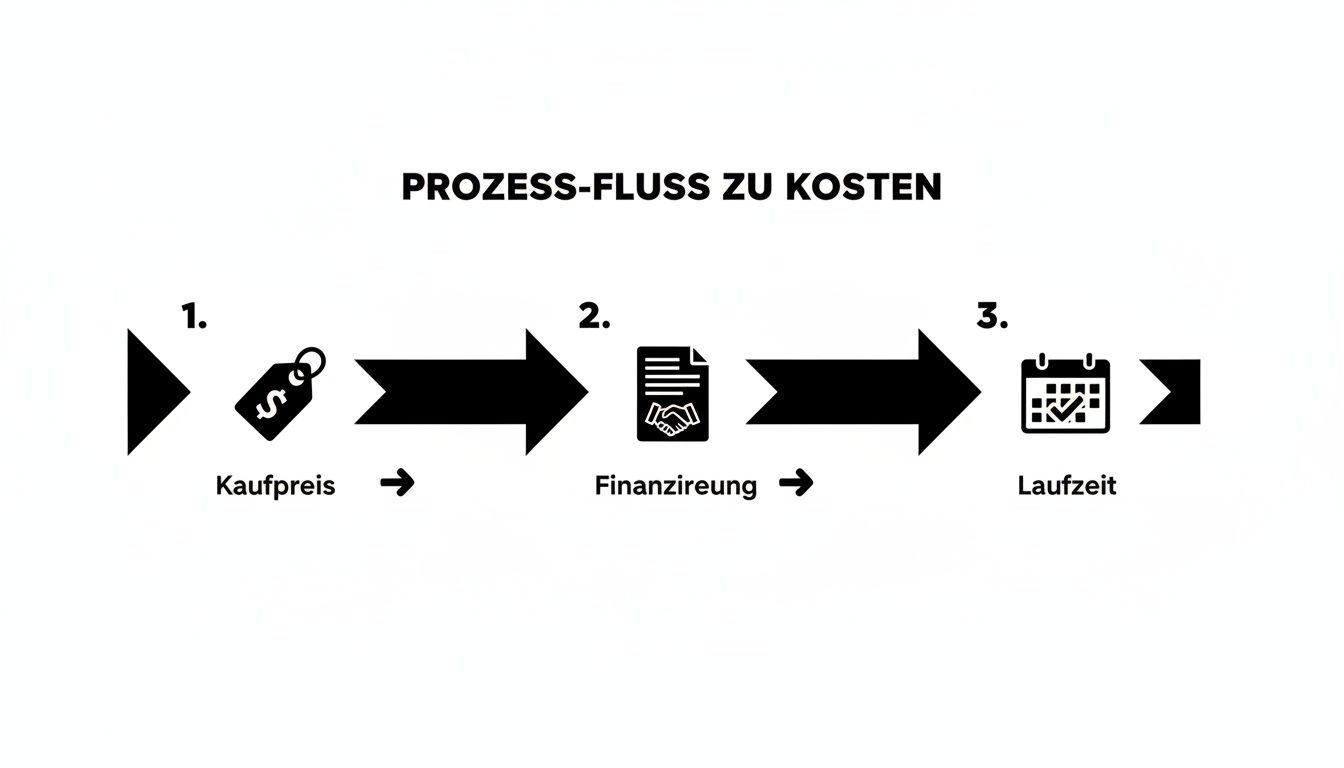
Here you can see very clearly how the value of the car decreases over time, while the loan amount is reduced more slowly. It is precisely this gap between value and debt that is covered by GAP insurance.
Incidentally, the GAP amount is almost always paid directly to the financing bank. This is practical because it clears your credit account in one go and the loan agreement is terminated cleanly. This means you don’t have to pay in advance or transfer money. In an already stressful situation, this frees up your mind and you can concentrate on getting a new car.
What really matters with GAP policies
At first glance, many offers for GAP insurance with financing look pretty much the same. But as is so often the case, the devil is in the detail – and it is precisely these details that can mean thousands of euros in an emergency. One crucial point that is often overlooked is the exact type of cover.
There are two basic variants here. You should definitely know the difference before you sign a contract, because the choice has massive financial consequences.
The net CAP: the pure gap filler
The most common and usually cheaper option is net GAP insurance. Its task is clearly and simply outlined: it closes the exact financial gap between the replacement value (what the comprehensive insurance pays) and the outstanding loan amount at the bank.
- Imagine this: Your remaining debt is still €18,000. After a total loss, the appraiser determines a replacement value of only €14,000. The net GAP steps in and pays exactly this difference of €4,000 to the bank. In the end, you are left without a car, but also without debt. Mission accomplished.
The gross GAP: the purchase price protection
The gross GAP, sometimes also called purchase price GAP, goes a big step further. It offers much more comprehensive protection. In the event of a claim, it reimburses the difference between the original purchase price of the vehicle and the replacement value.
- New scenario: Your new car cost €30,000. The replacement value is now only €22,000 and your remaining debt is €25,000. The gross CAP not only pays the credit gap of €3,000, but the full difference in value of €8,000. The remaining €5,000 is yours – a perfect down payment for a new car.
A gross CAP therefore not only secures your financing, but also your originally invested capital. It puts you back in the same financial position as you were in on the day of purchase.
Especially with financing models such as leasing or balloon financing, the protection provided by GAP insurance is worth its weight in gold. It can cover up to 100 % of the difference, saving you from a deep financial hole. If you would like to know more about how you can protect your financing, you can find more information in our articles on car loans.
The risk of an uncovered financing gap is an issue that should not be taken lightly, especially in a car country like Germany. An article on ad-hoc-news.de, which sheds light on the situation of motor insurers, provides further insights into this topic.
Frequently asked questions about GAP insurance
So, now that we’ve worked our way through the world of GAP insurance, there are often still a few practical questions left unanswered. No problem, here are the answers to the most common uncertainties so that you can make a really well-rounded and safe decision for your car financing.
Can I take out GAP insurance retrospectively?
In short: Yes, you usually can. But don’t take too much time! Many insurers have very tight deadlines – often just a few weeks or months after you buy the car. So if you simply forget in the hustle and bustle of the dealership, all is not lost.
Nevertheless, there are good arguments for taking out insurance directly with the loan agreement. On the one hand, you are covered from the very first kilometer without any ifs and buts. On the other hand, the conditions are often noticeably better if the policy is included directly in the financing package. If you take out the policy later, take a very close look at the small print. There are often restrictions regarding the age or mileage of the car.
The best time to take out GAP insurance is and remains the day you buy your car. This way, you avoid annoying deadlines, a possible “no” from the insurer and are safe from the nasty loss of value trap from the very first minute.
Is GAP insurance always included with leasing?
A very clear no. This is one of the most common and unfortunately most expensive mistakes. Although it is true that many leasing contracts for new cars already have some kind of GAP protection built in, there is no guarantee of this. So take a close look at your leasing contract – read it with eagle eyes and, if in doubt, ask directly.
This protection is often completely lacking, especially with leasing offers for used cars or with smaller, less well-known providers. The financial gap between the residual value calculated in the contract and what a comparable car actually costs after a total loss can be even more brutal than with normal financing. If this protection is missing, a separate GAP policy is an absolute must.
What distinguishes it from residual debt insurance?
The two are often lumped together, but they could hardly be more different. They protect against completely different risks and complement each other at best, but never replace each other.
Imagine it like this:
- GAP insurance is pure property insurance that only covers your car. It protects your wallet by making up the difference between the replacement value and the outstanding loan amount if the car is gone – whether through total loss or theft.
- Residual debt insurance, on the other hand, is personal insurance. It takes effect if you are no longer able to pay the installments, for example due to sudden unemployment, a prolonged illness or, in the worst case, your death.
Put simply: the GAP protects the sheet metal, the residual debt insurance protects you as the person behind it.
Are you ready to put your car financing on a really secure footing? At Finanz-Fox, you not only get the right loan, but also the clear and honest advice you need to make smart decisions. Compare the best offers now with no obligation and drive into the future with peace of mind. Visit us at https://www.finanz-fox.de and find the best way to your dream car.