If you’re faced with the decision of whether to finance or lease your next car, there’s a pretty simple rule of thumb: financing means you’re heading for ownership – ideal for a long-term commitment. Leasing is more like renting for a period of time. Perfect for those who like to drive the latest model every few years and don’t want to worry about reselling.
So your choice essentially depends on what is more important to you: building up a tangible asset or enjoying maximum flexibility with often lower monthly installments.
Financing or leasing – what suits me better?
The question of how best to finance the next big purchase – be it a car or an expensive machine – is a major concern for many people. Financing or leasing? There is no general right or wrong answer here. Rather, it’s about finding the solution that fits your life and financial situation like a glove.
Let’s look at the whole thing without complicated technical jargon. The essential difference revolves around a single question: who is the owner in the end and who bears the associated responsibility?

The fundamental difference in a nutshell
Financing is basically a classic installment purchase. You take out a loan to buy something, pay it off in installments and when the last installment is paid, the good thing is yours. From that moment on, you have complete freedom: You can convert it, sell it or simply keep driving it for as long as you want. However, you also bear the full risk of depreciation.
Leasing is a different matter. Here, you rent the vehicle for an agreed period of time and only pay for its use, so to speak. The monthly installments are therefore often significantly lower. At the end of the term, you simply return the car. Simple and uncomplicated.
The key consideration is: do you want to pay for ownership or just for use? The answer to this question is the first and most important step in your decision.
Direct comparison: financing vs. leasing
To give you a quick overview, we have directly compared the most important points of both models. This allows you to see at a glance which aspects are most important to you personally.
Direct comparison of financing vs. leasing
A comparison of the key features of financing and leasing as a quick initial decision-making aid.
| Feature | Financing | Leasing |
|---|---|---|
| Property | You become the owner with the last installment. | You are only the user, the vehicle remains the property of the lessor. |
| Monthly costs | The installments are often higher because the entire value is financed. | The installments are usually lower, as only the loss in value is paid for. |
| Flexibility | Rather low; an early sale can prove complicated. | Very high; simply switch to a new model at the end of the contract. |
| Freedom of use | Completely unlimited. No mileage limits or regulations for conversions. | Limited by contractually agreed mileage and condition. |
| Responsibility | You bear full responsibility for maintenance, repairs and depreciation. | Less responsibility; service packages can often be booked or are even included. |
| End of contract | The vehicle is yours. You can keep it, sell it or give it away. | You return the vehicle. Any additional payments for damage or extra mileage. |
This overview should serve as a kind of compass for the more detailed comparisons that we have prepared for you in the following sections. If you would like to delve even deeper into the world of credit options, you will find valuable further information in our articles on the subject of financing. You will then be well equipped to make an informed decision that is right for you.
A closer look at the key differences
So, the basics are clear. But now let’s get into the details, because this is where the wheat is separated from the chaff. The decision between financing and leasing is often determined by little things that seem inconspicuous at first glance, but can end up costing you a lot of money or throw your plans overboard.
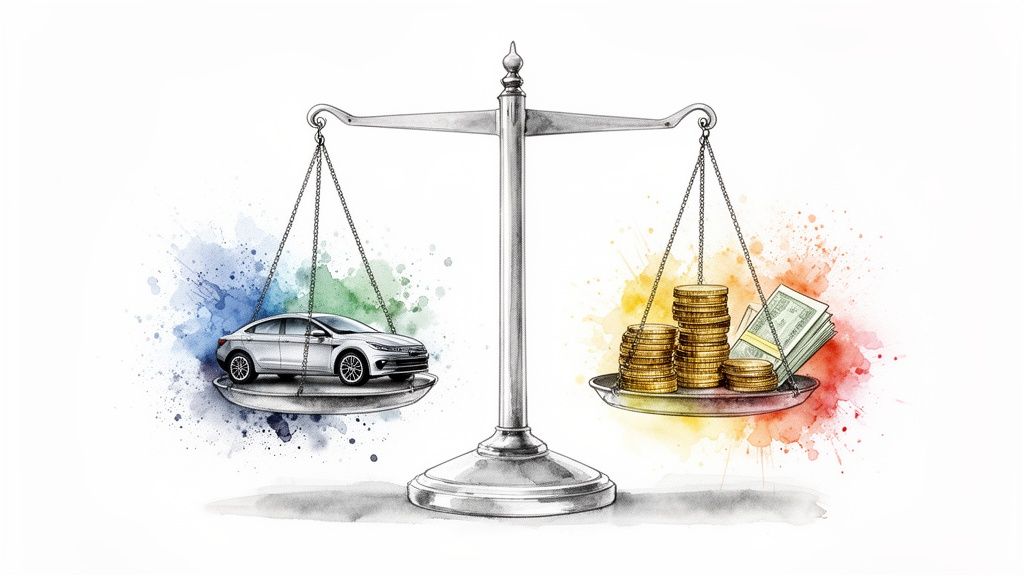
The question “Financing or leasing, which is better?” cannot be answered in general terms. It all depends on what is important to you. To find out, we need to look not only at the monthly rate, but also at the overall package of ownership, costs and flexibility.
Who really owns the car? The question of ownership and freedom
The most fundamental difference, which affects everything else, is the question of ownership. With financing, you own the vehicle bit by bit. Each installment you pay is like another building block of your property until it is completely yours after the last payment.
And what does that mean in practice? Absolute freedom.
- No mileage restrictions: you can drive wherever and as often as you like. Nobody counts the kilometers.
- Don’t worry about the residual value: Sure, depreciation is your concern. But in the end, you don’t have to worry about whether a small dent or scratch will lead to expensive deductions.
- Your car, your rules: Fancy new rims, a different color or a technical upgrade? Go ahead! It’s your property, you can customize it however you like.
The world looks different with leasing. Here you are basically just the lessee. You pay to use the car for a certain period of time. Although this relieves you of responsibility, it also restricts your freedom considerably.
The cost structure: What is the bottom line?
A low leasing rate on an advertising poster looks great, of course. But it is often only half the truth. To make a really fair comparison, we need to look at all the items.
With financing, usually a classic installment loan, the calculation is quite simple: there is the purchase price, a possible down payment, the loan amount, interest and the monthly installment. In the case of balloon financing, there is also a large final installment at the end, which pushes down the monthly payments. If you want to delve deeper into the topic, you can find everything you need to know about installment loans in our guide everything you need to know about installment loans.
The leasing rate is a more complex structure. It is made up of various parts:
- The expected loss in value of the car
- Administrative costs of the leasing company
- An interest component and, of course, the profit margin
In addition, there are often costs lurking that only come to light when the vehicle is returned. These can be additional payments for every excess kilometer driven or deductions for signs of use that go beyond the “normal”.
At first glance, leasing often seems cheaper because you only pay for the depreciation. Financing seems more expensive because you are paying off the entire value of the vehicle – but at the end of the day you get a tangible return.
Current figures show how popular leasing is. A study from 2024 shows that lessees in Germany prefer contracts over 24 months with 10,000 kilometers per year. Although the average gross list price of the cars climbed to 47,088 euros, the installments fell to an average of 295 euros. Particularly interesting: 58 percent of the contracts were concluded by private individuals, who paid an average of just 224 euros per month. You can find more exciting insights in the leasing trends on leasingmarkt.de.
Flexibility at the end of the contract – blessing or curse?
This is where leasing shines: at the end of the term, you simply return the car and, if you wish, step straight into a brand new model. Perfect for anyone who always wants to drive the latest car and doesn’t want to deal with the hassle of reselling it.
But this convenience comes at a price. Returning the vehicle is the most critical moment of the entire contract. Every scratch is scrutinized, and high additional payments are unfortunately not uncommon.
Financing offers a different kind of flexibility. As soon as the last installment is paid, the car is yours. You have full control: continue to drive it, sell it privately or trade it in as a deposit for the next owner. The proceeds from the sale are entirely yours. You bear the sales risk, but you also determine the rules of the game.
When leasing or financing is worthwhile for you
There is no general answer to the question of whether leasing or financing is the better option. The right decision depends very much on your personal situation: Are you a private individual with individual wishes or an entrepreneur who needs to think strategically and fiscally above all else? Both methods are absolutely justified, but serve completely different needs.
For private individuals, the choice is often a very personal, sometimes even emotional matter. In business, on the other hand, it is a hard-nosed business calculation. It’s all about liquidity, balance sheet ratios and clever optimization of the tax burden. Let’s take a look at the two scenarios separately to provide some real clarity.
Financing or leasing as a private individual
When you are faced with this decision as a private customer, everything usually revolves around the central question: ownership or use? The desire to truly own a car or other item is an important factor for many.
Financing is the classic route to ownership. It is just right for you if you:
- Think long-term: You want to drive your car for many years, far beyond the typical three to four years of a leasing contract.
- Love your independence: No mileage limits, no worries about minor scratches that can quickly become expensive when you return your lease – you’re your own boss.
- Appreciate individuality: Would you like to customize your vehicle to your heart’s content? New rims, a special wrap or technical upgrades are no problem for your property.
Leasing, on the other hand, comes into its own when your priorities are flexibility and absolutely calculable costs. It is the perfect choice if you:
- regularly want to drive the latest new thing: They love the smell of a new car and always want to be technologically up to date.
- Appreciate planning security: Fixed monthly installments, often combined with service packages, give you full cost control. No nasty surprises.
- do not want to worry about reselling the car: At the end of the term, you simply return the car and choose the next one. You save yourself the stress and risk of a private sale.
So the crux of the matter is really the question of ownership. For many, the feeling that the car belongs to them is priceless. Others appreciate the freedom of leasing, precisely because they are aware of how much of a burden ownership can be. In the end, it’s a personal trade-off between the freedom of ownership and the convenience of pure use. If you decide to buy, you will find in our overview of various car loans for useful information on suitable financing models.
Financing or leasing for companies and the self-employed
For tradespeople, the self-employed and companies, the focus has shifted completely. It is not emotions that count here, but hard facts from business management. The decision between financing and leasing has a direct and tangible impact on liquidity, the balance sheet and the tax burden.
For companies, leasing is often more than just a financing alternative; it is a strategic instrument for managing liquidity and optimizing the balance sheet structure.
For most companies, leasing is simply the smarter choice. The monthly leasing installments can be immediately and fully deducted as operating expenses, which directly reduces the tax burden. Because the vehicle is not included in the company’s fixed assets, the balance sheet remains lean. This improves the equity ratio and therefore often also the creditworthiness with banks.
Financing, on the other hand, means that the vehicle must be capitalized as an asset in the balance sheet. It is then depreciated over its official useful life. This means that you can only deduct the annual depreciation (AfA) and the interest on the loan – not the entire installment. This ties up capital unnecessarily and inflates the balance sheet.
Here is a direct comparison of the most important points for companies:
| Aspect | Leasing for companies | Financing for companies |
|---|---|---|
| Tax treatment | Installments are immediately and fully deductible as operating expenses. | Only depreciation and interest are deductible. |
| Balance sheet impact | Balance sheet neutral; the vehicle does not appear under fixed assets. | The vehicle is capitalized; the balance sheet total increases. |
| Liquidity | Protects liquidity as there is no high purchase price. | Ties up capital or requires a loan to be taken out. |
| Plannability | Fixed, easily calculable monthly costs. | Costs can also be planned, but the balance sheet burden is higher. |
The importance of leasing for the German economy should not be underestimated. A KfW study has shown that one in four euros invested by small and medium-sized enterprises (SMEs) flows through leasing – that is an impressive 61 billion euros. While only 28 percent of SMEs use traditional bank loans, as many as 55 percent of companies with over 50 employees use leasing. It is a real stabilizer for investments because it avoids high one-off payments and protects liquidity.
A practical cost comparison with examples
Theory is a good thing, but at the end of the day, numbers speak the clearest language. To really answer the question “Financing or leasing, which is better?”, let’s leave the gray theory behind and dive right into the practice. We’ll calculate two very specific scenarios for a typical mid-range car with a purchase price of €35,000 – one as a classic financing arrangement and one as a leasing contract.
For our comparison, we assume an identical term of 36 months and an annual mileage of 15,000 kilometers. This ensures that we really are comparing apples with apples and that you get a realistic feeling for the financial burden.
Scenario 1: Traditional financing
Imagine you decide to buy a car. You make a down payment of €5,000 and finance the remaining €30,000 with a car loan. Assuming an effective annual interest rate of 5.0%, this results in a monthly installment of around €899 over a term of 36 months.
The total costs are then made up as follows:
- Down payment: € 5,000
- Sum of the installments (36 x € 899): 32.364 €
- Total payment for the vehicle: € 37,364
At the end of the three years, the car is yours. Let’s assume that the residual value of the car after this time is still 50% of the new price, i.e. a realistic €17,500. Your actual financial outlay – i.e. the loss in value plus the interest costs – therefore amounts to €19,864 (€37,364 – €17,500).
Scenario 2: The leasing contract
And now to leasing. Here, often no or only a small down payment is required. Let’s assume a one-off special payment of €2,000 to keep the monthly installments attractive. A typical leasing offer for this vehicle could be a monthly rate of €350.
The calculation over 36 months looks quite different here:
- Special leasing payment: € 2,000
- Sum of the installments (36 x € 350): 12.600 €
- Total payment for pure use: € 14,600
At the end of the contract, you simply return the car. The loss in value is already factored into the installments and is therefore no longer your problem. At first glance, of course, this seems much cheaper. But caution is advised: Additional costs for extra mileage or damage on return are not taken into account here.
The decisive difference lies in the result: with financing, you have an asset of €17,500 in the garage after three years. With leasing, you may have spent less, but you will end up empty-handed.
Cost comparison over 3 years for a mid-range car
In order to make a fair decision, we need to directly compare the total costs and the actual expenditure. The following table summarizes our calculation example and shows where the money goes.
| Cost point | Financing (example) | Leasing (example) |
|---|---|---|
| Down payment/special payment | 5.000 € | 2.000 € |
| Monthly installment | 899 € | 350 € |
| Total payment (36 months) | 37.364 € | 14.600 € |
| Remaining vehicle value | 17.500 € | 0 € |
| Real expense (loss of value + costs) | 19.864 € | 14.600 € |
In this example, leasing appears to be over €5,000 cheaper. However, this comparison is somewhat misleading as it completely ignores the freedom of ownership and potential follow-up costs of leasing. If you sell the financed car after three years, the proceeds are yours. With leasing, a careless return of the vehicle can quickly wipe out the initial savings.
Nevertheless, the popularity of leasing remains unbroken on the car market. Current data shows that almost half of all new registrations(48.4%) in Germany are leased or financed by installment plan. The total leasing volume for passenger cars amounted to an impressive 50.14 billion euros. This underlines how much many people and companies appreciate flexible rates without the burden of ownership.
This infographic shows impressively how much leasing is used by companies in particular.
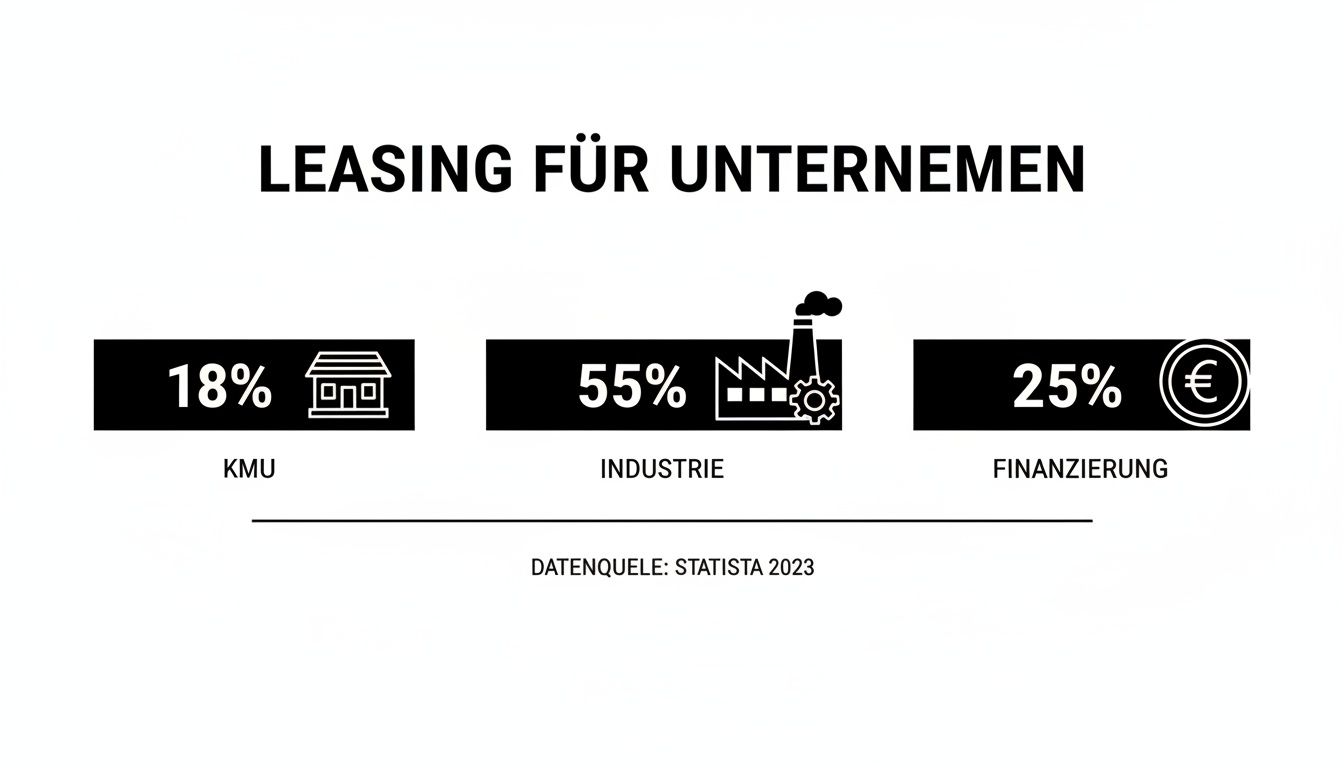
The figures make it clear that leasing is a key strategic instrument, especially for larger companies, to keep their vehicle fleets modern and their balance sheets lean.
Ultimately, you need to weigh up what is more important to you personally: the potentially lower overall cost and convenience of leasing, or the freedom and long-term value of ownership through financing. If you’re considering the finance route, it’s worth taking a close look at the terms. You can also read our guide on how to find the best deal with a loan comparison.
Your personal checklist: Which path is right for you?
Now you have the facts, figures and sample calculations on the table. But the crucial question – financing or leasing – can only be answered if you take an honest look at your own needs. This checklist is designed to help you gain clarity.
Take a moment to do this. Go through the following questions point by point. Your answers will show you the way, because it’s all about making a decision that you’ll be happy with for years to come.
Question 1: What does ownership mean to you?
That is the crucial question in this decision. For many, the thought of holding something of real value in their hands at the end of the term – be it a car, a machine or an expensive IT system – is simply incredibly important.
- When ownership counts (towards financing): You nod and think: “Sure, in the end I want the car to be mine. I want to be able to keep it, sell it or maybe even pass it on.” Then financing is clearly the way to go. This is about building up assets.
- When the focus is on utility (towards leasing): They tend to think: “Ownership is just ballast that loses value. I just always want to drive the latest model without worrying about all the rest.” If this is your attitude, then leasing suits you perfectly.
Question 2: How well can you plan your future?
Realism is required here. How well can you estimate how you will use the car or machine over the next few years? Unexpected costs or even your freedom often depend on this.
In leasing, mileage is the most common reason for hefty additional payments. An honest assessment of your driving habits will save you from a nasty surprise at the end of the contract.
- Mileage: Do you cover a similar distance every year, or could a new job or a move throw everything out of kilter? Financing gives you complete freedom here. With leasing, on the other hand, a precise calculation is worth its weight in gold.
- Handling and wear and tear: Are you the meticulous type, or is a scratch no problem for you? With a financed car, you decide for yourself what constitutes normal wear and tear. In the case of a leased vehicle, this is ultimately determined by an expert when the car is returned.
Question 3: How important is flexibility to you?
Your life planning is a crucial point. Do you want to make a longer commitment or would you prefer to reshuffle the cards every few years?
- Fancy something new: Do you love technical progress and want to drive the latest model every two to three years without having to worry about reselling it? This is precisely the core promise of leasing.
- Security and longevity: Do you see your car as a loyal companion for many years and don’t want to have to make a new decision as soon as the contract expires? Then financing gives you the stability you are looking for.
Once you have thought through these points, a clear picture should slowly emerge. There is no blanket “better” or “worse” – there is only a “more suitable” or “less suitable” for your own personal situation.
If financing is the best option for you, the next step is to secure the best conditions. Find out in our guide which tips and tricks for a successful loan application really help.
Financing or leasing: what else you should know
Now that we have shed light on the major differences between financing and leasing, detailed questions often arise that can be crucial in everyday life. Finally, let’s clarify some of the most frequently asked questions that we encounter time and again in practice.
These answers from the field should take away the last uncertainties and help you to make a decision that feels right in the long term.
How do financing and leasing affect my credit rating?
Both methods – financing and leasing – leave traces at credit agencies such as SCHUFA, but the type of trace is different. A classic loan for financing is entered there as a normal liability. If you always pay your installments on time, this can even have a positive effect on your score. This proves that you are a reliable contractual partner.
Although a leasing contract is also reported, it is weighted differently. It counts more like a regular payment obligation, comparable to rent. As you are not acquiring property, a leasing contract generally places less of a burden on your credit rating than a large credit line.
What if I want to get out of the contract earlier?
Honestly? An early exit is a tricky and usually expensive affair with both models. With financing, you can of course repay the loan in full at any time. However, the bank then almost always charges a prepayment penalty to compensate for the interest it has lost.
You cannot simply terminate a leasing contract. The most common, but often laborious solution is to take over the lease. This means you have to find someone who will take over your contract under the existing conditions. However, whether this works always depends on the agreement of the lessor – there is no guarantee.
Whether you finance or lease: You are entering into a long-term commitment. There is no easy emergency exit with either option. You should bear this in mind from the outset.
What should I look out for in the “hidden” costs?
The small print can quickly turn a low rate into an expensive affair. With financing, the whole thing is still quite manageable. Here you should pay attention to possible processing fees and the exact conditions of optional residual debt insurance.
With leasing, the list of potential pitfalls is longer and requires a watchful eye:
- Extra kilometers: Every kilometer you drive more than agreed will end up costing you dearly. Calculate realistically here!
- Compensation for reduced value: scratches, dents or stains that go beyond normal signs of use can lead to hefty additional payments on return.
- Insurance requirements: Lessors often stipulate expensive fully comprehensive insurance, sometimes even with a fixed garage commitment.
So it really is worth going through the contract details point by point to avoid a rude awakening at the end.
Have you weighed up all the facts and flexible financing seems to be the right option for you? Finanz-Fox is here to help you find the right loan for your project. Our transparent loan calculator lets you run through various options so that you can discover the best offer for your situation. Start the comparison now and take a big step towards your plans.
Find your ideal loan now at https://www.finanz-fox.de.