
Buying a car without a down payment – for many, this sounds almost too good to be true. Yet it is often the smartest solution to get behind the wheel immediately without having to spend your hard-saved money in one go. You simply finance the entire purchase price and keep your reserves free for other important things. This is not a lazy compromise, but a genuine instrument for greater financial flexibility.
Why it is sometimes wiser to keep your savings
Just imagine: You are standing in front of your dream car and could drive off immediately. Often this is not just a wish, but simply a necessity. The old car suddenly gives up the ghost, the family needs more space or the new job cannot be reached without a vehicle. At times like these, you simply can’t wait.
This is exactly where full financing comes into its own. Instead of putting your savings into a car that loses value from the first kilometer, you keep your money in your account. This leaves you with a reassuring cushion for unexpected repairs, your next vacation or a sensible investment.
No longer a niche product in Germany
This pragmatic approach is becoming increasingly popular. Financing without equity has long since become a popular option in Germany, especially when it comes to new cars. Although average new car prices have only risen slightly to €44,560 according to the DAT Report 2026, which analyzes market trends for 2025, more and more buyers are opting for this option. A study shows: 23 percent of new cars were leased privately – many of these offers come without any down payment at all, making it super easy to get started. You can also find more background information in our guide to car financing on autoflex24.de.
The decisive advantage is that you are able to act immediately. You don’t have to postpone your plans, but can react directly to new life circumstances.
So it’s not a question here of affording a car that you can’t actually afford. On the contrary: it is a strategic decision to make clever use of your own capital. Instead of tying it up in an asset that is constantly losing value, it remains flexibly available. The only important thing is that you are well informed beforehand and understand the conditions exactly. Then financing without a down payment turns from an emergency solution into a really smart decision that creates freedom and security.
Which financing models really work without a down payment
Would you like a new car but prefer to leave your savings untouched? Welcome to the world of full financing! Many people think of a single, rigid route, but fortunately the reality is different. There are actually several tried and tested models that can be adapted to suit a wide range of needs.
Basically, it always comes down to one central question: What is most important to you? Do you want to be the legal owner of the car at the end of the term? Or do you want maximum flexibility because you don’t yet know what will happen in three or four years’ time? Perhaps you simply want to keep the monthly installment as low as possible.
This is exactly where the journey begins. The following graphic sums up the first decision point: use equity or stay liquid?
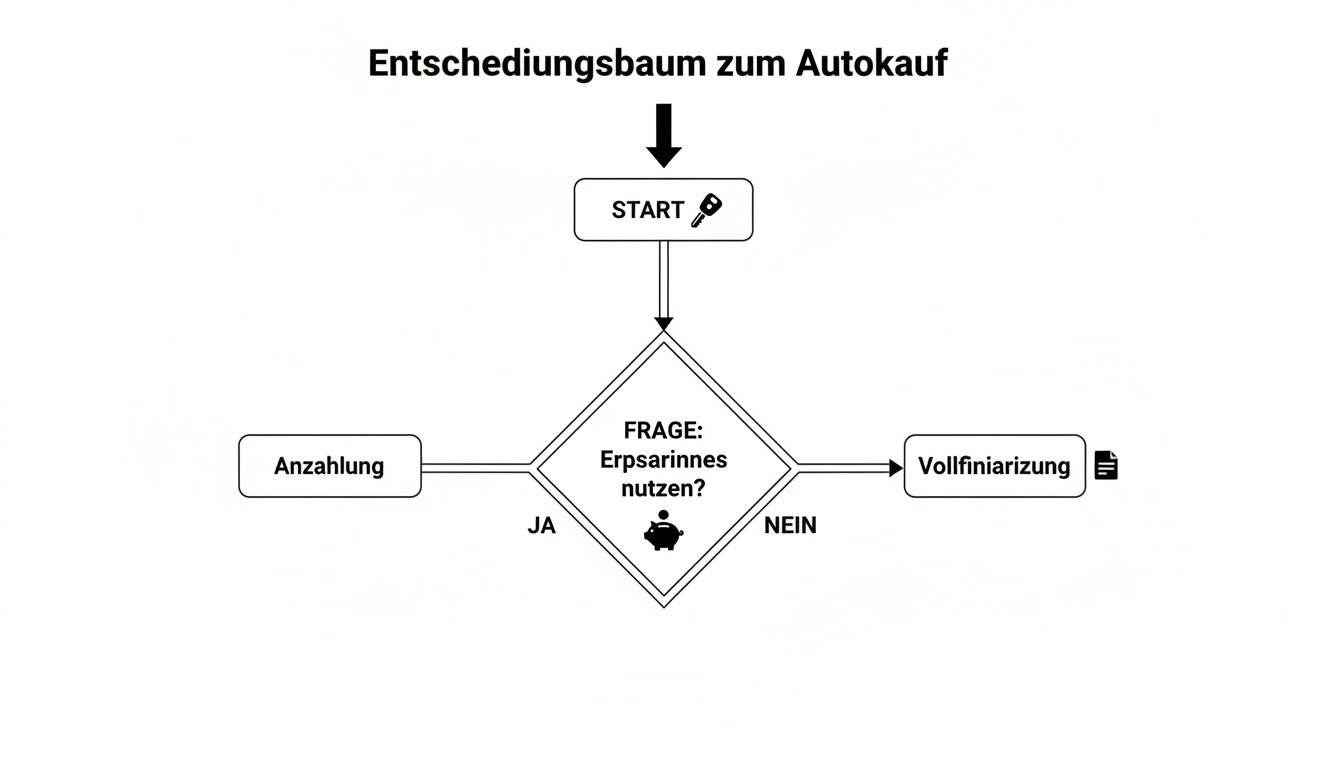
As you can see, opting for full financing is a conscious move to keep your own reserves available for other things. Let’s take a closer look at the three most common ways.
The classic installment loan: the direct route to ownership
The installment loan is the absolute classic – and for good reason. It is honest, transparent and uncomplicated. You borrow the full purchase price from a bank, pay it back in fixed monthly installments, and with the last transfer, the car is 100% yours. No ifs, no buts.
This model is ideal for anyone who likes planning security. You know from day one what to expect and that there will be no nasty surprises such as a high final installment at the end of the term.
3-way financing: maximum flexibility at the end of the contract
Often referred to as balloon financing, this model is a clever hybrid. The trick: the monthly installments are pleasantly low, but a larger final installment, the so-called “balloon”, awaits you at the end. The best thing about it is the three options you then have:
- Buy: You pay the final installment in one go (or from money you have saved) and you own the car.
- Continue financing: If you are short of cash, you can simply pay off the final installment with a new loan.
- Return: You return the car to the dealer and the matter is settled (provided the condition and kilometers are correct).
Perfect for anyone who doesn’t want to or can’t commit today. It keeps all doors open.
Leasing without a special payment: driving instead of owning
With leasing, you don’t buy the car, you rent it for a certain period of time. Car financing without a down payment works here by dispensing with the usual special leasing payment. The rates are often unbeatably low because you only pay for the depreciation during your period of use, not the entire value of the vehicle.
Leasing is the perfect solution if you want to drive a new model regularly and don’t want to worry about reselling it. At the end, you simply return the car.
This form of financing is no longer just popular for new cars. As used car prices are likely to remain stable at an average of €18,310 in 2025, around 49% of buyers will opt for financing – often without a down payment – according to a survey. Data from Leasingmarkt.de underpins this trend: in 2024, 38% of all leasing contracts were for used cars.
Choosing the right model is a very personal decision. If you would like to delve deeper into a direct comparison, I recommend our guide Leasing or car loan – which financing suits me?
Financing options without a down payment at a glance
To make the decision easier, we have summarized the most important features of the three models in a table. This allows you to see at a glance where the differences lie and which option best suits your situation.
| Feature | Classic installment loan | 3-way financing | Leasing without special payment |
|---|---|---|---|
| Monthly installments | Constant and predictable (rather higher) | Lower than an installment loan | Usually the lowest |
| Property at the end | Yes, automatically after last installment | Yes, after payment of the final installment | No, vehicle goes back |
| Final installment | None | Yes, a high “balloon rate” | None |
| Flexibility at the end | None, only property | Very high (buy, finance, return) | Low (return only) |
| Kilometer limit | No | Yes, relevant for return | Yes, with additional payments in the event of overruns |
| Ideal for | Buyers who want ownership and planning security | Undecided people who want to keep all their options open | Drivers who always want a new model and don’t want to tie themselves down |
Each model has its own charm. The installment loan offers clarity, 3-way financing offers maximum freedom of choice and leasing offers the lowest monthly costs. Your personal priority is the deciding factor in the end.
Your credit rating is the key to financing
Let’s be honest: car financing without a deposit is a considerable leap of faith for any bank. You get to borrow the full purchase price without having to put your own money on the table. Of course, lenders will only do this if they are absolutely convinced that you will be able to repay the installments reliably. Your strongest argument? A squeaky clean credit rating – or as the professionals say: a good credit rating.
But what exactly does “good credit rating” mean? It’s much more than just a pretty SCHUFA score. The banks look at the overall picture, like a mosaic of many small stones, to assess your personal risk. A small scratch in the paintwork does not immediately lead to rejection, but conversely a top score is not a free pass either.

What the banks really scrutinize
Put yourself in the banker’s shoes. Would you lend money to someone without making sure that they are on a stable financial footing? Exactly. This is exactly what banks do by looking at a few crucial points in your life and work situation.
These are the most important touchstones:
- A stable income: An open-ended employment contract is pure gold here. It signals to the bank that you have long-term security. Of course, your net income must also be high enough so that the loan installment is still easily covered after deducting all fixed costs.
- A clean payment history: Your SCHUFA information is the be-all and end-all here. It reveals whether you have always paid bills and installments on time in the past. Negative entries, for example due to defaulted loans or unpaid cell phone contracts, are often a direct knock-out criterion.
- Ongoing obligations: Do you already have other loans in place or high monthly expenses? The bank will make a tough calculation to see whether another installment will break your budget.
A good credit rating does not fall from the sky – it is the result of a responsible approach to your own finances. Think of it as your ticket to fair interest rates and the promise of your dream car with no down payment.
How to optimally prepare for the bank interview
Before you even fill out an application, you should do an honest check yourself and collect all the necessary documents. The better prepared you are, the more confident and convincing you will appear.
Your checklist for the application:
- Proof of salary: The last three payslips should be to hand. If you are self-employed, the bank usually needs the last two tax assessments or a current business analysis (BWA).
- Bank statements: You should also provide the bank statements for the last three months. The bank will use these to check your regular cash receipts and take a look at your spending structure.
- Request SCHUFA information: My tip: Order a free copy of your data from SCHUFA in advance. This way you can see for yourself whether all entries are correct. You can have incorrect or outdated data deleted before the bank sees it.
If you have your finances under control and have all your documents to hand, you not only speed up the whole process, but also show that you can be relied upon. Would you like to delve deeper into the topic and find out how you can strengthen your financial trustworthiness in a targeted manner? You can find useful practical tips under the keyword creditworthiness at finanz-fox.de. A little preparatory work can really make all the difference here.
Compare offers and uncover hidden costs
The first offer that flutters through the door often looks fantastic. A low monthly payment flashes up and the dream car suddenly seems within reach. But this is exactly where you need to be careful, because this is where the real work begins. If you only look at the installment, it’s easy to overlook where the real costs of car financing without a down payment lurk: in the small print.
To avoid falling into an expensive trap, you need to learn to dissect the offers like a pro. The key is to differentiate between two terms: the borrowing rate and the APR.
The borrowing rate is effectively the “net price” for the money borrowed. However, the APR is the figure that really counts. All additional costs such as processing fees are already included here. Only with this figure can you compare offers fairly and honestly.

Run through various scenarios with the loan calculator
An online loan calculator is your best friend in this phase. It brings the numbers to life and shows you immediately how small changes will affect your finances.
Let’s imagine you want to finance 20,000 euros.
- Scenario 1: You choose a term of 48 months with an APR of 5.39%. This results in a monthly installment of around 463 euros.
- Scenario 2: To reduce the monthly installment, you extend the term to 60 months. The installment drops to a more comfortable 381 euros. The catch? You end up paying significantly more interest.
This simple simulation game exposes the eternal trade-off between a low monthly payment and high total costs. It helps you to find a way that fits your budget without you ending up paying more. You can find useful tools and practical tips for calculating different options in our guide to loan comparison made easy.
The typical cost traps in the small print
As we all know, the devil is in the detail – or in this case, in the small print of the loan agreement. This is where the pitfalls are hidden that can quickly turn supposedly favorable financing into a nightmare.
This should set alarm bells ringing:
- Residual debt insurance (RSV): This is often sold to you as an absolute must, but in most cases it is expensive and superfluous. Take a critical look at whether you really need this protection – you are often better and cheaper off with separate term life insurance.
- Hidden processing fees: Even though they have become less common, they sometimes reappear under a different name. Always ask explicitly about all one-off costs incurred at the start.
- No free unscheduled repayments: A good contract gives you the freedom to pay in extra money at any time to get rid of the loan faster. This saves you money in the end. If this option is missing, you are trapped.
- High penalty interest rates for early redemption: Life is unpredictable. What if you need or want to sell your car before the contract ends? A hefty early repayment penalty can throw a huge spanner in the works.
A low interest rate is only half the battle. You can recognize real financial freedom by fair contractual conditions that give you the necessary leeway for everything that life brings.
The market for car financing without a down payment is highly competitive. On the one hand, manufacturers such as Audi offer special 0% financing for certain models that cover the entire purchase price. However, caution is advised here, as this is often at the expense of discounts that you would otherwise have received.
On the other hand, there is the classic installment loan. A look at comparison portals shows: For 20,000 euros over 48 months, PSD Bank offers an effective interest rate of 5.39%, resulting in a monthly installment of 463 euros. Studies show that 56 percent of buyers set themselves a budget of between 15,000 and 50,000 euros. Take the time to really check the offers thoroughly – it can save you thousands of euros in the end.
From application to signature: how to get financing
Fortunately, getting car finance without a deposit is no longer a gauntlet. Forget the days when you had to make a pilgrimage from bank to bank with thick files. Thanks to digital applications, such as those found on comparison portals, the whole process has become much more relaxed and, above all, faster.
Everything usually starts with a non-binding request for terms and conditions online. You type in your key data and receive your first customized offer within minutes. The best thing about it? This step is completely SCHUFA-neutral. So you can look around at your leisure without your score suffering. Only when you say: “This is the offer!” do you submit the binding application to the selected bank.
Well prepared for the meeting – how to negotiate properly
Whether you are sitting at the car dealer or talking directly to a bank advisor – good preparation is half the battle. After all, it’s not just about getting a commitment, it’s about getting the best possible conditions for yourself.
With these arguments, you have the best cards for a top interest rate:
- Your creditworthiness is your strongest asset: talk openly about your good SCHUFA score and your fixed income. You are a low-risk customer and this should be reflected in the interest rate.
- Show that you have done your homework: Feel free to put an (anonymized) competitor’s offer on the table. This clearly signals that you know the market and won’t take the first offer that comes along.
- Flexibility as a bonus point: Actively ask about the possibility of making special repayments free of charge. This shows foresight and underlines that you want to repay the loan reliably and perhaps even faster than planned.
A good negotiator is not an aggressive barker, but someone who is well informed. Show that you have your finances under control and know exactly what a fair offer is.
The option to make unscheduled repayments is worth its weight in gold. It gives you the freedom to put an unexpected bonus or a small inheritance directly into the repayment. This saves you a lot of interest costs in the end and shortens the term. Insist on it – it’s a clear sign of quality for a customer-friendly contract. If you want to arm yourself even better, you can find valuable tips and tricks for a successful loan application in our guide.
The final check: what counts before signing
You have negotiated, the offer is in front of you – now comes the most important moment. Make sure you take the time to go through the contract at your leisure. Your signature is binding, so every detail must be right.
Take a particularly close look at these clauses:
- Effective annual interest rate: Is the exact interest rate that you have negotiated noted here? A brief comparison with the offer is mandatory.
- Special repayment right: Is the option for free special repayments clearly anchored in the contract without hidden fees?
- Early repayment penalty: What does it cost if you want to pay off the loan completely early? The amount is limited by law, but the exact conditions should still be fair.
- Additional products: Check the small print carefully. Has an expensive residual debt insurance or another package that you didn’t want been slipped in unnoticed?
Only when you have understood every point and all the conditions are as you have discussed should you sign. This will ensure that your dream of a new car is on a really solid financial footing.
Frequently asked questions about car financing without a deposit
Financing a car without a deposit is a big decision. It goes without saying that a lot of questions arise. From my experience in countless consultations, I know where the shoe pinches for most people. Let’s go through the four most common concerns openly and honestly so that you can start planning with a good feeling.
Loan with a fixed-term employment contract – is that even possible?
Honestly? It’s tricky, but definitely doable. Banks love security, and a permanent contract is the ultimate for them. But that doesn’t mean the door is closed for you.
The decisive lever is often the term: if you structure the loan agreement so that it expires within your fixed term, your chances increase enormously. Another trump card can be a second borrower with a permanent job and good credit rating, for example your partner. Be transparent in your discussions with the bank, explain your career prospects and perhaps back this up with a complete CV. This will work wonders.
What happens if I can’t pay the high final installment for balloon financing?
This one huge installment at the end – the “balloon” – gives many people a stomach ache. But don’t panic if you don’t have the money ready on the due date. There are basically three established ways out of this situation:
- Return the key: The simplest solution. You return the car to the dealer. The buyback value is often guaranteed when the contract is signed, which gives you great planning security.
- Follow-up financing: This is the classic option. The final installment is simply converted into a new, normal installment loan. But bear in mind that this naturally makes the car more expensive at the end of the day.
- Sell it yourself: You can also offer the car on the open market. If you achieve a price that is higher than the final installment, you may even make a small profit.
Is zero-percent financing really a gift?
On paper, it’s true: With 0% interest, you don’t pay a cent extra. But the catch is usually lurking in the small print, or in the purchase price. Such tempting offers are almost always linked to the hard-calculated list price of the car.
That means: no haggling, no discount, no cash discount. Always do the math! A normal installment loan for a car, where you could negotiate a 15% discount, is almost always the cheaper option in the end.
0% financing is not a gift, but a marketing tool. The costs are usually already hidden in the vehicle price. Always compare the total costs, not just the interest rate!
Will a credit application destroy my SCHUFA score?
We need to make a clear distinction here, as this is a widespread misconception. If you use a comparison portal such as Finanz-Fox to obtain various offers, you simply initiate a “request for loan conditions”. This is 100% SCHUFA-neutral. So you can compare dozens of conditions and your score won’t budge.
The situation is different if you have decided on an offer and submit the final, binding application to the bank. This is then a “credit application”, which is noted in your file. Too many such binding applications in a short period of time can actually lower your score. It then looks as if you are desperately searching and being rejected everywhere. If you need to apply quickly, our instant loan comparison guide will show you how to get the money you need without SCHUFA risk.
As you can see: With the necessary knowledge, the road to a new car without equity is not so rocky. We at Finanz-Fox are at your side to filter out the best conditions for you and clear up any uncertainties. Simply start your no-obligation comparison at https://www.finanz-fox.de – and move a decisive step closer to your dream car.



8 Responses
best canadian online pharmacy reviews
recommended canadian online pharmacies
online canadian pharmacies
pharmacies online
canada pharmacy
online canadian pharmacy with prescription
legitimate canadian pharmacy
canadian pharmacy no prescription required