
Debt restructuring is a fairly simple but very effective idea: you replace one or more old, often expensive loans with a single, new and cheaper loan. The aim? To pay less interest, reduce the monthly installment and finally get a clear overview of your finances again.
When debt restructuring really makes sense for you
Many of us pay too much interest on our loans for years without even realizing it. Interest rates today may be much lower than when you signed your installment loan a few years ago. Rescheduling is therefore not a distress signal, but a clever financial move. You simply use the current market conditions to your advantage.
But how do you recognize the right moment to take this step? There are a few classic situations in which the whole thing pays off.
High interest rates for old installment loans
The most common reason is clearly a high interest rate on an existing installment or car loan. If interest rates on the market have fallen since you signed the contract, you are probably paying more. A new loan with a lower APR can significantly reduce your monthly payment. A difference of just one or two percentage points can mean savings of several thousand euros over the years.
Bundle several loans and gain an overview
Does this sound familiar? A loan for the car, one for the new kitchen and then a smaller one for the broken washing machine. It’s easy to lose track of the various installments, due dates and contact persons. And it’s often expensive too.
Debt restructuring combines all these debts into a single, clearly structured loan. For you, this means: only one installment, one contractual partner and, in most cases, a significantly lower total monthly burden. You regain control immediately.
A nice side effect: by combining several small loans and paying them off cleanly, this can even have a positive effect on your SCHUFA score. After all, a tidy financial situation signals reliability.
Repay an expensive overdraft facility
The overdraft facility is practical, no question about it. But it is also one of the most expensive debt traps of all. Interest rates are often in the double-digit range – if you are permanently in the red, you pay huge sums without the mountain of debt really getting any smaller. Rescheduling your overdraft with a cheap installment loan is almost always the right decision. You immediately pay less interest and pay off the debt with a fixed installment.
This type of financial optimization is becoming increasingly important. Many households are under financial pressure following the crises of recent years – the pandemic, energy prices and inflation. Savings are often exhausted. This is also reflected in the figures: in 2025, around 5.67 million people in Germany were considered over-indebted, 111,000 more than in the previous year. Those who actively manage their loans create valuable financial leeway. You can find more details on this in the Debtor Atlas Germany 2025 at creditreform.de.
Follow-up financing for real estate
Another classic case is the end of the fixed interest period for a mortgage. After 10 or 15 years, the follow-up financing for the remaining debt is due. This is the perfect time to look around the market instead of blindly accepting the offer from your house bank. Rescheduling to another bank can often secure you significantly better conditions and therefore a lower rate for the next few years.
Your roadmap to successful debt restructuring
Debt restructuring often feels like a huge project, but don’t worry. With a clear plan in hand, the whole thing becomes manageable and manageable. Just think of it as a major overhaul of your finances that will result in a lower monthly payment and more breathing room.
Basically, it’s quite simple: you swap one or more expensive old loans for a single, new and cheaper loan. The result? A direct and often noticeable saving.
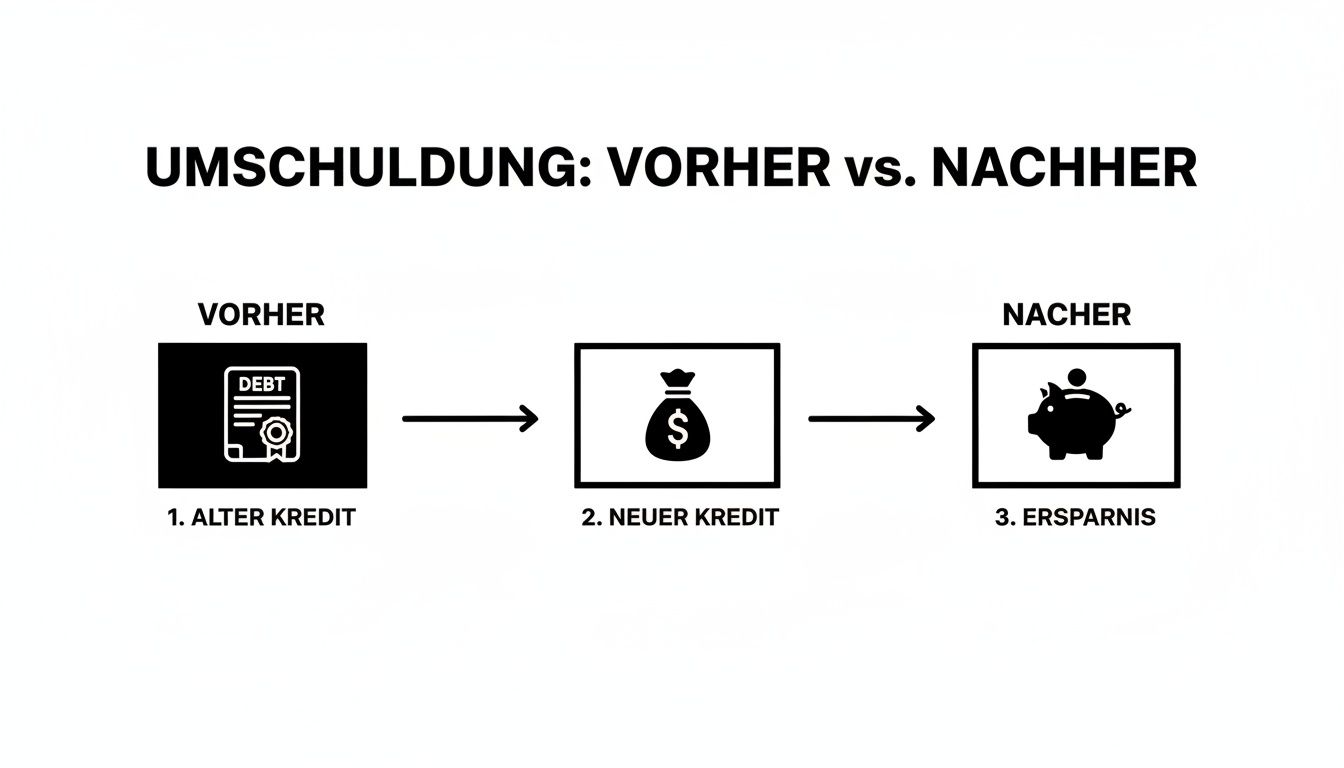
This simple formula puts you back in control of your finances and saves you money in the long run.
Kassensturz: First create clarity
The very first step is to get an honest overview. Before you obtain even a single quote, you need to know exactly where you stand financially. Grab a folder or a simple spreadsheet and put everything together.
This belongs on your list:
- All current loans: Make sure you list everything – from installment loans and car financing to overdrafts.
- Exact remaining debt: How much money do you still owe for each individual liability? You can find the total in online banking or on your last loan statement.
- Your current conditions: Make a note of the APR, monthly installment and remaining term for each loan.
This overview is your foundation. It shows you in black and white how much you spend on debt each month and where the greatest savings potential lies dormant.
Obtaining quotes – but the right way
With your financial overview in hand, you can start looking for the right debt restructuring loan. And here the following applies: Don’t take the first offer that comes along! A thorough market comparison is now the be-all and end-all.
The easiest way to do this is with a modern loan comparison calculator. Simply enter the desired loan amount – i.e. the sum of all your remaining debts – and play around a little with the term.
You will soon realize: a longer term means a lower monthly payment, a shorter term saves interest costs. This will help you find the perfect balance for your budget.
The most important thing here is that such an inquiry is always a SCHUFA-neutral condition inquiry. It therefore has no negative influence on your score. So take your time to compare and always pay attention to the effective annual interest rate. Only this value includes all costs and makes the offers truly comparable.
Make an application and complete the paperwork
Once you have found a top offer, it gets serious: the official loan application. Every bank is legally obliged to carry out a thorough credit check and will therefore request a number of documents from you.
To speed up the process, it is best to have these documents ready:
- Proof of income: Usually the last three payslips.
- Account statements: Generally without gaps for the last 30 to 90 days.
- Existing loan agreements: The contracts of the loans you wish to redeem.
- Redemption authorization: A form that allows your new bank to terminate and redeem the old loans for you.
- Proof of identity: Copy of identity card, often conveniently via video identification procedure.
My tip: Submit everything neatly and completely. This not only makes a good impression, but also speeds up the approval process enormously.
Smooth replacement – how to make the switch
As soon as your new loan has been approved and signed, your new bank takes over. Thanks to the transfer power of attorney, it will take care of everything else: it will contact your old creditors, clarify the exact remaining debt on the key date and transfer the money. You no longer have any work to do.
This service is a huge advantage. It ensures that everything runs smoothly and that there are no duplicate payments. After successful repayment, you will receive written confirmation from your old banks that the loans have been settled. Keep these letters in a safe place. From now on, you will only pay the one, new and cheaper installment to your new bank.
The most common cost traps – and how to elegantly steer around them
Debt restructuring can save you hundreds, sometimes even thousands of euros. But to be honest, there are often a few stumbling blocks along the way. If you don’t know the typical pitfalls, you will reduce your savings or perhaps even end up paying more. With the right insider knowledge, however, these hurdles can be easily overcome.

The first and by far the biggest hurdle that almost everyone encounters is the so-called early repayment penalty. It sounds cumbersome, but is quickly explained: it is a kind of “penalty fee” that your old bank charges because it loses interest as a result of your early repayment.
The early repayment penalty: No reason to panic
The good news first: the legislator has set clear limits here to protect us consumers. With normal installment loans, the bank cannot simply demand whatever it wants.
This is what the legal caps look like:
- If your loan has a remaining term of more than 12 months, the compensation may not exceed 1% of the remaining loan amount.
- If the contract only runs for less than 12 months, the rate even drops to a maximum of 0.5% of the remaining debt.
Let’s imagine this in concrete terms: Let’s say you still have €10,000 outstanding and the contract would normally run for another two years. In this case, the bank may charge you a maximum of €100 (that’s 1% of €10,000). No more than that.
My most important piece of practical advice: Before you change your debt, ask your old bank for the exact transfer amount including this fee. Only with this figure can you properly calculate whether the change will really pay off for you in the end.
Always calculate with a sharp pencil: the interest savings from the new loan must significantly exceed the one-off costs of the debt restructuring – i.e. the early repayment penalty. It usually does, but a proper calculation is the be-all and end-all.
Incidentally, real estate loans are a completely different matter, as there is often no statutory upper limit. Many homeowners whose fixed interest rates expired in recent years have experienced this painfully. If they had old contracts with 1-2% interest rates, they were suddenly faced with follow-up financing with 4% or more.
The classic: overpriced residual debt insurance
Another point where many people burn money unnecessarily is residual debt insurance (RSV for short). Bank advisors like to sell it as standard cover against risks such as unemployment or illness. It sounds sensible at first, but these policies are often hopelessly overpriced and the conditions in the small print are full of pitfalls and exclusions.
The tricky thing about this is that the costs for RSV are usually added directly to the loan amount. This means that you also pay interest on the insurance costs! An expensive double effect. So think very carefully about whether you really need this protection. Separate term life insurance is often a much cheaper and better alternative.
Excessively long terms and the spectre of hidden fees
The choice of term is a huge lever for the overall costs. Of course, a longer term means a lower monthly payment and initially creates breathing space in the budget. But over the years, you will pay an enormous amount of interest.
Rule of thumb: Always choose a term that is as short as possible, but whose installment you can still comfortably afford. Fortunately, many modern loan agreements, as explained in our guide to installment loans, allow for free unscheduled repayments. This gives you the flexibility to simply get rid of the loan more quickly if you run out of money.
Also, always take a close look at the small print. Processing fees have been off the table since a ruling by the Federal Court of Justice, but sometimes costs lurk elsewhere – for example for account management or any optional service packages. You can recognize a reputable offer by the fact that all costs are shown transparently in the APR.
The SCHUFA dilemma with ill-considered inquiries
One final point that many people underestimate is the impact on your SCHUFA score. If you now go out and submit credit inquiries to ten different banks to compare offers, this can backfire. Each of these “sharp” inquiries will be stored at SCHUFA and can worsen your score.
Fortunately, the solution is quite simple: only use comparison portals that make a SCHUFA-neutral condition inquiry. This is more or less a non-binding preliminary check that does not harm your credit rating. Only when you have decided on a specific offer and officially submit the application will you receive a binding credit inquiry. This keeps your score clean and gives you the best chance of getting top interest rates.
A look into practice: How debt restructuring really works
Figures and tables are one thing. But real-life stories are the best way to show what smart debt restructuring can really achieve. Stories of people like you and me who have regained control of their finances and more room to breathe by taking a targeted step.
So let’s take a look at two typical but anonymized cases from practice.

Perhaps one of these situations sounds familiar to you.
Case study: The Schmidt family bundles their debts – from three loans to one installment
The Schmidt family had simply lost track of things over the years. First came the installment loan for the new furniture. Then an unplanned but expensive car repair that also had to be financed. And finally a smaller loan for new technology. The overdraft was the final straw: the current account had been constantly in the red by around €2,500 for months – an extremely expensive affair with interest rates above 12%.
Financially, the whole thing looked like this:
- Furniture loan: €150 installment (remaining debt €4,000 at 7.9% interest)
- Repair loan: €100 installment (remaining debt €2,500 at 8.5% interest)
- Technical loan: € 70 installment (remaining debt € 1,000 at 9.2 % interest)
- Overdraft interest: approx. 25 € per month
Every month, a total of €345 went out of the account, spread across four different creditors. The feeling of never really having anything to pay off and only having holes to fill became a burden.
The Schmidts pulled the ripcord and decided to restructure their debt. They consolidated all their debts – i.e. the €10,000 – into a single new loan. A careful comparison brought them a top offer with an effective annual interest rate of just 4.5% and a term of 60 months.
The following table shows how the family’s financial situation has improved as a result of the debt restructuring.
| Schmidt family case study: From three loans to one installment |
| :— | :— | :— |
| Parameters | Before the debt rescheduling | After the debt rescheduling |
| Number of loans | 3 + overdraft facility | 1 |
| Total remaining debt | € 10,000 | € 10,000 |
| Average interest rate | approx. 8.5 % (+ expensive overdraft facility) | 4.5 % |
| Monthly installment (total) | 345 € | 186 € |
| Monthly savings | – | 159 € |
| Total interest savings | – | approx. € 1,800 |
The result was immediately noticeable: the new installment was only €186. This gave the family € 159 more leeway in their budget each month. Over the entire term, the family saved over €1,800 in interest alone.
But the most important gain was not just financial. At last there was a clear overview again: one rate, one bank, one fixed plan. The feeling of having your finances firmly under control again was priceless. If you also want to go down this path, you will find valuable tips and tricks for a successful loan application in our guide.
Case study: Mr. Meier and the clever view of the car loan
Mr. Meier was happy with his new car, which he had easily financed directly with the dealer. Two years later, he took a closer look at his documents and stumbled across the APR: a whopping 6.8%. The remaining debt at this point was exactly €12,000 and the term was still 36 months.
That made him curious. He used an online comparison calculator and made a non-binding request for terms and conditions. The best offer he received was an APR of just 3.9%.
Mr. Meier pulled out his calculator:
| Parameters | Old merchant credit | New debt rescheduling loan |
|---|---|---|
| Effective annual interest rate | 6,8 % | 3,9 % |
| Monthly installment | approx. 369 € | approx. 354 € |
| Total interest costs (remaining term) | approx. 1.284 € | approx. 744 € |
At first glance, the savings of €15 per month do not seem huge. However, as is so often the case, the devil is in the detail – namely the total costs. By switching, Mr. Meier saved a whopping €540 in pure interest costs over the remaining three years.
He has already offset the early repayment fee of €120 (1% of the remaining debt). Even after deducting this fee, he still made a tidy profit. A clever move.
These real-life examples show that debt restructuring is not rocket science. It is a powerful tool to actively improve your financial situation – regardless of whether you want to regain control or simply make clever savings on interest.
What alternatives there are to debt restructuring
Debt restructuring is a powerful tool, no question about it. But hand on heart: it’s not always the only real way to get your finances back on track. Sometimes there are cleverer, faster or simply more suitable solutions that you should be aware of before you set the whole debt restructuring machine in motion.
Not every expensive loan has to be completely paid off immediately. There are often opportunities hidden directly in your existing contract that you may not even have had on your radar.
Talk to your bank
Before you run straight to the competition, knock on the door of your bank first. As a long-standing and reliable customer, you often have more leverage than you might think. Lay your cards on the table, explain your situation and ask directly for better conditions.
Sometimes this one phone call is enough to lower the interest rate on the existing loan. After all, your bank has a vested interest in keeping you as a customer and is often more willing to compromise than you might think.
Use unscheduled repayments as an interest rate turbo
An often underestimated but extremely effective alternative is the unscheduled repayment. Do you have money available unexpectedly – be it through a bonus from your boss, a small inheritance or simply disciplined saving? Perfect! Use it to reduce your remaining debt in one fell swoop.
Many modern loan agreements allow free unscheduled repayments up to a certain amount per year. Every extra euro you pay off reduces the interest burden and shortens the term. Be sure to take a look at your contract – this is one of the best ways to become debt-free more quickly without having to take out a completely new loan.
A practical tip: set up a small standing order on a call money account that is only intended for the next special repayment. Even small, regular amounts add up and can make a real difference at the end of the year.
Short-term relief through deferral or installment break
Is the problem only temporary because the washing machine has broken down or an expensive car repair is due? Then rescheduling existing loans doesn’t have to be the solution. Talk to your bank about a deferral or installment break.
These options are intended as a short-term bridging solution. They do not solve the fundamental interest rate problem, but they give you valuable breathing space. Incidentally, flexibility is more important than ever. Even the German government has had to massively expand its debt restructuring capacity: The credit authorization for this was doubled from 15 to 30 billion euros for 2025. This shows how dynamic the market is, as the analyses of the German Federal Audit Office make clear.
Seek professional help
If your debts are getting out of hand and the options mentioned are simply no longer enough, seeking professional debt advice is the only right and, above all, courageous step to take. Reputable contact points (for example from Caritas or Diakonie) will look at your situation objectively and work with you to develop a plan that really works. This is not a sign of weakness, but of strength and a sense of responsibility.
Remember: there is a solution for almost every financial situation. Sometimes it’s a major debt restructuring, but often it’s one of these smaller but equally effective steps. Stay informed, also about related topics – for example in our comparison between leasing and car loans.
Frequently asked questions about debt restructuring – what you really need to know
When you think about debt restructuring, you often have very practical questions buzzing around in your head. It’s these small uncertainties that may make you hesitate. That’s why I’ve compiled the most common concerns here and given you clear, practical answers so that you can get started with a good feeling.
Will debt restructuring ruin my SCHUFA score?
This is probably the biggest concern for many people. But I can reassure you: A smart approach to rescheduling existing loans can even improve your SCHUFA score in the long term.
The crux of the matter is to distinguish between two types of requests:
- Condition request: This is what happens when you request offers on comparison portals. This inquiry is SCHUFA-neutral. This means that you can play through various options without any negative consequences.
- Credit inquiry: Only when you decide on a bank and officially submit the application will this inquiry be noted. Yes, this can have a minimal impact on your score in the short term.
In the long term, however, the advantages clearly outweigh the disadvantages. If you combine several loans into a new one and then service it on time, SCHUFA will see that you have your finances under control. A cleanly repaid old loan is always a plus point.
A little insider tip that many people overlook: If you bundle several small loans, you will end up with fewer creditors. That alone will make your financial situation look much tidier and more stable to SCHUFA.
How long does the whole circus actually last?
Don’t worry, you don’t have to wait for months. The time from the initial idea to the final repayment of the old loan is usually shorter than you think.
Realistically, you should expect one to a maximum of three weeks. The process looks something like this:
- Compare offers: It’s lightning fast. Online, you often have the first non-binding proposals on the table after just a few minutes.
- Submit application & check: Once you have found your favorite, submit the documents. With most modern online banks, the check only takes a few working days.
- The redemption: Once the new loan has been approved and paid out, your new bank will take care of everything else. It contacts the old bank and arranges the repayment. This exchange between the banks is usually the part that takes some time.
My practical tip: It’s best to scan all important documents such as salary statements and old loan agreements in advance. If you have everything ready digitally, the application process will be much quicker.
Can I really refinance any loan?
In principle, yes, but there are subtle differences depending on the type of loan. Some are easier to refinance, others require a closer look.
Completely uncomplicated and most frequently rescheduled:
- Installment loans: the absolute classic. Whether for the couch, the TV or the last trip – paying it off is usually child’s play.
- Car loans: Here too, debt restructuring is often possible without any problems in order to secure better interest rates.
- Overdraft facilities: this is almost always a stroke of financial genius. You swap the horrendous overdraft interest for a fair installment loan. This is practically always worthwhile.
On the other hand, construction financing with a long fixed interest rate or special KfW subsidized loans require special attention. The rules are stricter here and an early repayment penalty can eat up the savings. But even here, debt restructuring is not impossible, especially when the end of the fixed interest rate period is approaching. If you want to delve deeper into such topics, you can find more helpful advice in our general loan tips on finanz-fox.de.
Ready to regain control of your finances and benefit from better interest rates? At Finanz-Fox you can find transparent offers, compare at your leisure and secure the right debt restructuring loan. Start your no-obligation comparison now at https://www.finanz-fox.de and see for yourself how much you can save.